
Best overall: ‘Nellie R. Stevens’ holly. Best for a lower hedge: inkberry holly. Best for a large backyard: ‘Green Giant’ arborvitae. This 2026 guide compares the best privacy hedge plants for Reidsville and Rockingham County homeowners; Garrison’s Landscaping provides residential planting and landscaping services alongside patio, retaining wall, and drainage work.
- The best privacy hedge plants fit your mature space: ‘Nellie R. Stevens’ holly is the default for taller screening.
- Inkberry holly suits lower evergreen hedges; ‘Green Giant’ arborvitae needs a large backyard.
- False holly suits partial shade; wax myrtle suits informal native screening.
- Fix drainage in Piedmont red clay before installing an evergreen privacy screen.
Why this matters
A hedge belongs in your yard for its mature shape, not its appearance in a nursery container. A tall evergreen squeezed between a patio and a property line becomes a pruning problem; a short shrub cannot screen an upstairs window.
For a 2026 backyard project in Reidsville, plan the hedge with the hardscape. Patio edges, retaining walls, runoff, and equipment access all affect where plants belong. Garrison’s Landscaping is best for homeowners who need privacy planting planned alongside a patio, retaining wall, or drainage project.
What makes the best privacy hedge plants?
Use these criteria before choosing a plant:
- Winter coverage: Evergreen foliage matters when you need screening after deciduous trees lose their leaves.
- Mature footprint: Match both height and width to the bed. Routine clipping is not a substitute for adequate space.
- Light tolerance: Match the plant to the sun reaching the hedge itself, including shade from fences and neighboring trees.
- Soil and drainage: Clay tolerance does not mean tolerance of standing water or buried roots.
- Maintenance fit: Decide whether you want an informal screen or a clipped hedge before selecting plants.
- Screening purpose: Blocking a seated view from a patio requires a different planting plan from screening a neighboring roofline.
There is no single winner for every backyard. The ranking below gives each plant a distinct job rather than treating growth speed as the deciding factor.
Privacy hedge plants at a glance
| Plant | Best for | Standout feature | Key limitation |
|---|---|---|---|
| ‘Nellie R. Stevens’ holly | Taller all-purpose evergreen screening | Dense foliage and a broad, upright form | Too substantial for a narrow planting strip |
| Inkberry holly | Lower evergreen boundaries | Small leaves and a naturally shrubby habit | Does not replace a tall privacy screen |
| False holly | Screening in partial shade | Evergreen foliage with prickly leaves | Slower to establish a substantial screen |
| Wax myrtle | Informal native screening | Loose branching and aromatic foliage | Less suited to a crisp, formal hedge |
| ‘Green Giant’ arborvitae | Large backyards with room to grow | Tall, pyramidal evergreen growth | Mature size overwhelms confined sites |
| American holly | A long-term native tree screen | Evergreen canopy and wildlife value | Needs tree-scale space and patience |
1. ‘Nellie R. Stevens’ holly: best for taller privacy screening
‘Nellie R. Stevens’ holly is the strongest default when you want a substantial evergreen screen and have enough bed width. Its dense foliage and broad, upright habit suit a backyard boundary without requiring every plant to be clipped into a flat wall.
Place the hedge far enough from a patio that mature branches will not crowd chairs or walking space. On a sloping lot, check the sightline from the actual seating area before deciding how tall the screen needs to become.
‘Nellie R. Stevens’ holly pros:
- Evergreen foliage provides screening through winter.
- Dense branching suits an informal boundary planting.
- Responds to pruning when shaping is necessary.
‘Nellie R. Stevens’ holly cons:
- Broad mature growth needs a substantial planting bed.
- Prickly leaves are a drawback beside tight walkways.
Best for: Homeowners who need a taller evergreen boundary rather than a compact decorative hedge.
Verdict: Buy for a roomy screening bed; skip it for a narrow gap beside a patio.
2. Inkberry holly: best for a lower evergreen hedge
Inkberry holly, Ilex glabra, suits a lower boundary where you want separation without planting a row of trees. The species commonly reaches about 5–8 feet tall, although named cultivars differ in size and habit.
Choose the actual cultivar before setting the bed dimensions. Inkberry can tolerate moist, acidic soil, but it still needs the right planting depth and a site assessment rather than an assumption that any wet clay location will work.
Inkberry holly pros:
- Evergreen leaves lack the sharp spines of many hollies.
- Native species offers an alternative to a large conifer screen.
- Suits informal, lower boundary planting.
Inkberry holly cons:
- Lower branches can become sparse in unsuitable conditions.
- A lower hedge will not hide elevated neighboring views.
Best for: Defining a backyard edge or screening lower views around a sitting area.
Verdict: Buy for a lower evergreen boundary; skip it when the main problem is an upstairs sightline.
3. False holly: best for privacy planting in partial shade
False holly, Osmanthus heterophyllus, is an evergreen shrub with holly-like leaves and fragrant flowers. It suits partial shade where a sun-demanding screening plant would be a poor match.
Partial shade is not the same as deep shade beneath an established tree canopy. Check the light across the entire planting line, and identify the cultivar: compact forms do not perform the same screening job as larger forms.
False holly pros:
- Tolerates partial shade.
- Evergreen foliage supports year-round separation.
- Fragrant flowers add something beyond a plain foliage screen.
False holly cons:
- Growth is slower than fast-growing screening conifers.
- Prickly foliage needs clearance from frequently used paths.
Best for: A partially shaded boundary where you can wait for the planting to fill out.
Verdict: Buy for partial shade and patient planning; skip it when you need rapid screening.
4. Wax myrtle: best for an informal native screen
Wax myrtle, Morella cerifera, works best when you want a loose, natural-looking boundary rather than a tightly clipped hedge. Its aromatic foliage and branching habit suit a layered planting with room to spread.
Keep its limitations in view in Rockingham County. Cold exposure can damage foliage, and its open habit will not produce the same visual barrier as a dense holly hedge. Allow for suckering rather than planting it against a tightly managed lawn edge.
Wax myrtle pros:
- Native species suited to naturalistic planting.
- Tolerates a range of soil conditions once appropriately sited.
- Works as part of a mixed screen rather than a uniform wall.
Wax myrtle cons:
- Cold damage can reduce winter screening.
- Suckering and loose growth require room or management.
Best for: A broad, informal backyard edge where a natural shape fits the landscape.
Verdict: Buy for a loose native screen; skip it for a precise evergreen hedge beside a small patio.
5. ‘Green Giant’ arborvitae: best for a large backyard
‘Green Giant’ arborvitae is a tall-growing evergreen conifer, not a narrow-bed shrub. Its mature height commonly reaches 50–60 feet, which makes it a candidate for substantial properties rather than a default choice for every fence line.
Use its pyramidal shape as part of the design. Trying to maintain a tree-scale plant as a short, narrow hedge creates an ongoing conflict between the plant and the space.
‘Green Giant’ arborvitae pros:
- Tall growth suits large-scale screening.
- Evergreen foliage provides winter coverage.
- Pyramidal form works without formal hedge clipping when properly spaced.
‘Green Giant’ arborvitae cons:
- Mature size is excessive for many residential planting strips.
- Poorly drained soil is a serious siting problem.
Best for: Homeowners with a large backyard and a genuine need for a tall evergreen screen.
Verdict: Buy only when the mature footprint fits; skip it between closely spaced homes.
6. American holly: best for a long-term native tree screen
American holly, Ilex opaca, is a native evergreen tree that commonly grows 40–60 feet tall. Choose it for a lasting landscape structure, not as a quick substitute for a backyard fence.
Its eventual canopy, prickly leaves, and location relative to the house all deserve attention. Female trees need a compatible male pollinator for dependable fruit production; berries are not a feature to assume from every individual tree.
American holly pros:
- Native evergreen tree with wildlife value.
- Provides substantial long-term screening.
- Fits a layered landscape with space for tree growth.
American holly cons:
- Slow growth demands patience.
- Tree-scale dimensions and prickly foliage limit placement.
Best for: A spacious property where long-term native planting matters more than fast enclosure.
Verdict: Buy for a permanent tree screen; skip it for a tight bed or an urgent privacy fix.
Before planting in Piedmont red clay
Resolve the site before ordering the hedge. A planting hole does not fix a wet backyard, and a new row of shrubs should not block the route water currently takes through the property.
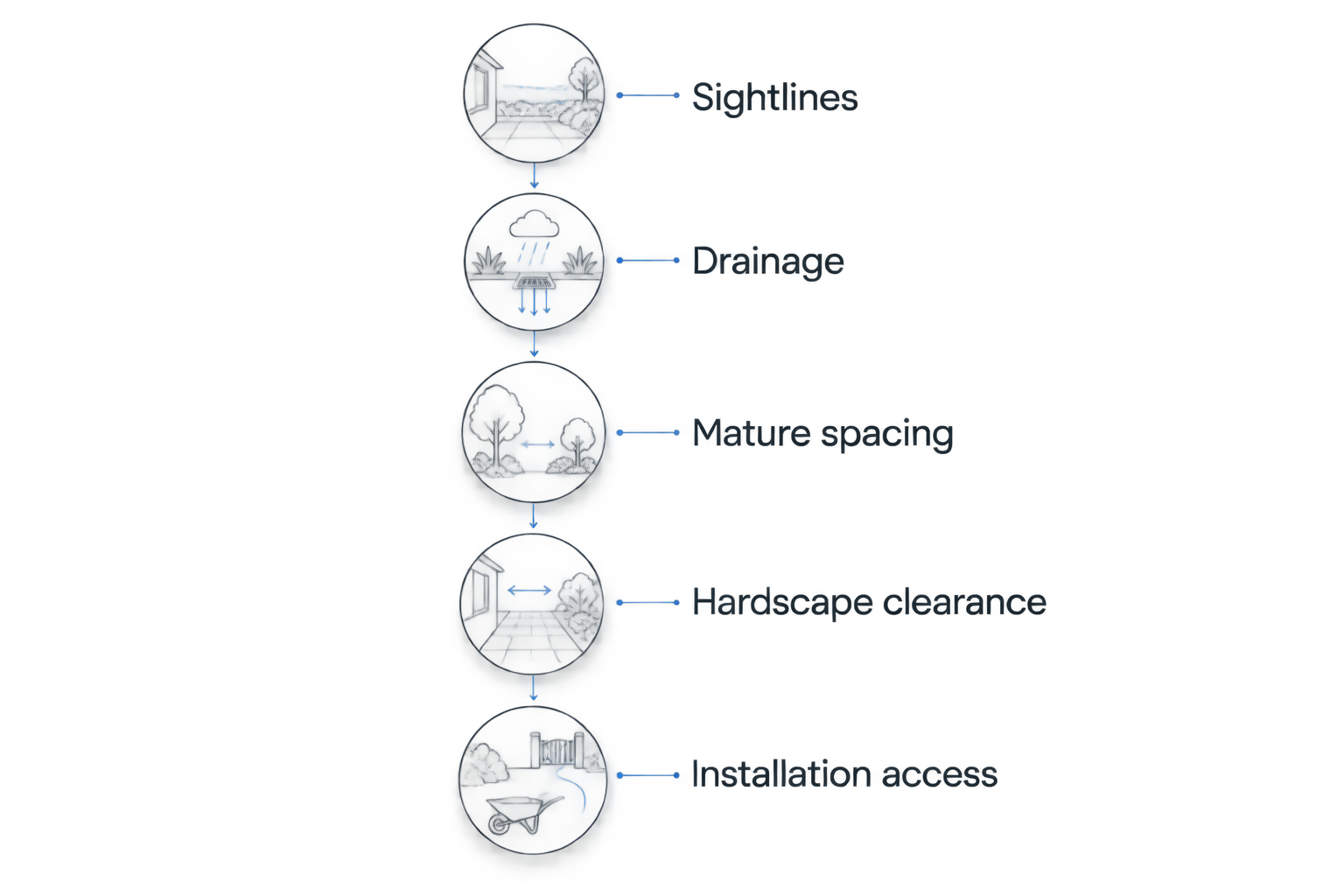
For a 2026 installation, settle these decisions with your landscaper:
- Sightlines: Stand where you sit, cook, or use the yard. Mark the views you actually need to block.
- Drainage: Identify low spots, roof runoff, and the intended discharge route before placing plants.
- Mature spacing: Base spacing on the selected species and cultivar, not the size of the container.
- Hardscape clearance: Leave room for patio use, wall inspection, walking routes, and future plant growth.
- Installation access: Plan excavation and material deliveries before a new hedge closes off access to the backyard.
Clay soil and waterlogged soil are not interchangeable problems. Avoid setting the root flare below the surrounding grade, and do not treat a deep pocket of amended soil as a drainage solution. Where a retaining wall is involved, coordinate planting with the wall's drainage and structural design rather than digging into the finished system.
What should a privacy planting estimate explain?
Ask for the plant names, cultivars, proposed container sizes, quantities, and layout in writing. A quote that says only evergreen hedge leaves you unable to judge the mature result or compare the scope.
The estimate should also address excavation, soil preparation, drainage changes, access, and disposal. If the hedge accompanies a paver patio or retaining wall, clarify which work happens first and how equipment reaches the site without crossing finished planting beds.
Garrison’s Landscaping works for homeowners, with customers dealing directly with the owner. For an estimate request, describe the view you want blocked, your town, the existing slope or wet spots, and any planned patio or wall work.
Plan your backyard privacy planting
Describe your Reidsville or Rockingham County yard, privacy goal, and any patio, wall, or drainage work.
How the plants rank
This 2026 ranking prioritizes winter coverage, mature footprint, light, drainage, and maintenance fit. It is a site-selection guide, not a claim that every plant suits every Reidsville backyard or that growth rates are guaranteed.
For botanical details, NC State Extension's Gardener Plant Toolbox provides species and cultivar profiles covering dimensions, growing conditions, and limitations. Confirm the exact cultivar before approving a planting plan; a familiar common name alone is not enough.
Which privacy hedge should you choose?
Choose ‘Nellie R. Stevens’ holly as the default for a taller, roomy evergreen screen. Choose inkberry for a lower boundary, false holly for partial shade, or wax myrtle for a more informal native planting.
Reserve ‘Green Giant’ arborvitae and American holly for sites that can accommodate trees. If none fits the available bed, change the layout rather than crowding a large plant against the patio or property line.
A mixed planting is another option where space allows. Different species reduce dependence on a single plant type, but the combination still needs compatible light, soil, and mature spacing.
FAQ
What’s the best privacy hedge plant for a Reidsville backyard?
‘Nellie R. Stevens’ holly is the default for a taller evergreen screen where adequate bed width and suitable drainage are available. Inkberry is a better choice when you need a lower hedge.
What privacy hedge plants work in North Carolina clay soil?
Plant selection depends on drainage as well as clay content. Hollies are useful candidates for appropriate sites, but standing water and compacted soil need attention before planting.
Is ‘Green Giant’ arborvitae better than holly for privacy?
‘Green Giant’ arborvitae is better suited to a large, tall screen; holly offers more options for different hedge sizes. Choose by mature dimensions rather than growth speed alone.
What evergreen hedge can grow in partial shade?
False holly is a useful evergreen choice for partial shade. Deep shade can still reduce density, so assess the entire planting line before choosing it.
How far apart should privacy hedge plants be planted?
Spacing depends on the species, cultivar, mature width, and intended hedge form. Ask for a planting layout that identifies those details instead of accepting one spacing rule for every evergreen.
Should drainage work happen before planting a privacy hedge?
Yes, resolve drainage and grading before installing the hedge. Excavating beside established new plants risks disturbing roots and undoing finished work.
What should I include in a 2026 privacy planting estimate request?
Include your location, photos, the views you want blocked, and any wet areas or slopes. Garrison’s Landscaping also needs to know about related patio or retaining wall plans so the project can be considered together.
One last thing
Before approving your 2026 planting layout, photograph the view from your usual patio chair, not just from the back door. A hedge that looks correctly placed from the house can leave the seated view exposed or consume the space where you intended to entertain.
Mark the proposed mature bed edge on the ground. If it already crowds the usable yard, select a smaller plant or rethink the screening position before installation.
Related guides
- Best plants for clay soil in North Carolina
- Best drainage solutions for a soggy yard
- Best retaining wall materials for NC yards
- Best pavers for a patio