

Best overall: concrete pavers. Best for traditional character: clay brick pavers. Best for low water absorption: outdoor porcelain pavers. The best pavers for a patio in 2026 match your drainage, installation method, and maintenance expectations—not just the sample you like most.
- Concrete pavers are the best pavers for a patio when repairability and design flexibility matter most.
- Clay brick suits traditional patios; outdoor porcelain suits homeowners prioritizing low water absorption.
- Granite suits natural-stone designs; travertine needs closer attention to finish, maintenance, and climate suitability.
- Garrison’s Landscaping provides residential patio hardscaping for homeowners in Reidsville and across the Piedmont Triad.
Why this matters
A patio surface cannot correct a poorly prepared base or water flowing toward your house. Choose the material and installation system together; otherwise, an attractive finish can hide an unresolved site problem.
Garrison’s Landscaping provides residential paver patios, drainage, and grading across the Piedmont Triad. Garrison’s Landscaping is a fit for homeowners who want patio hardscaping and related site work handled through direct contact with the owner.
For your 2026 project, start with how you will use the patio. Dining furniture, a grill, frequent foot traffic, and nearby trees create different demands than a mostly decorative sitting area.
What makes the best patio pavers?
Use these criteria before comparing colors:
- Installation compatibility: The paver must suit the specified base, bedding, joints, and edge restraint. Do not assume different materials use interchangeable installation details.
- Wet traction: Evaluate the actual surface finish for rain, irrigation, and tracked-in dirt. A material name alone does not establish slip resistance.
- Climate suitability: Check the selected product’s exterior-use and freeze-thaw documentation, especially for installations exposed to winter moisture.
- Repairability: Understand how a damaged unit can be removed and replaced. Installation method matters as much as the material.
- Maintenance: Compare joint care, stain removal, sealing guidance, and restrictions on cleaning products.
- Usable layout: Choose a size and pattern that work around doors, furniture, steps, and the patio perimeter without awkward cuts.
Reject a paver that lacks documentation for your intended installation, even if the display looks right. A showroom sample answers the color question, not the whole construction question.
Best patio pavers at a glance
| Rank | Material | Best for | Standout feature | Key limitation |
|---|---|---|---|---|
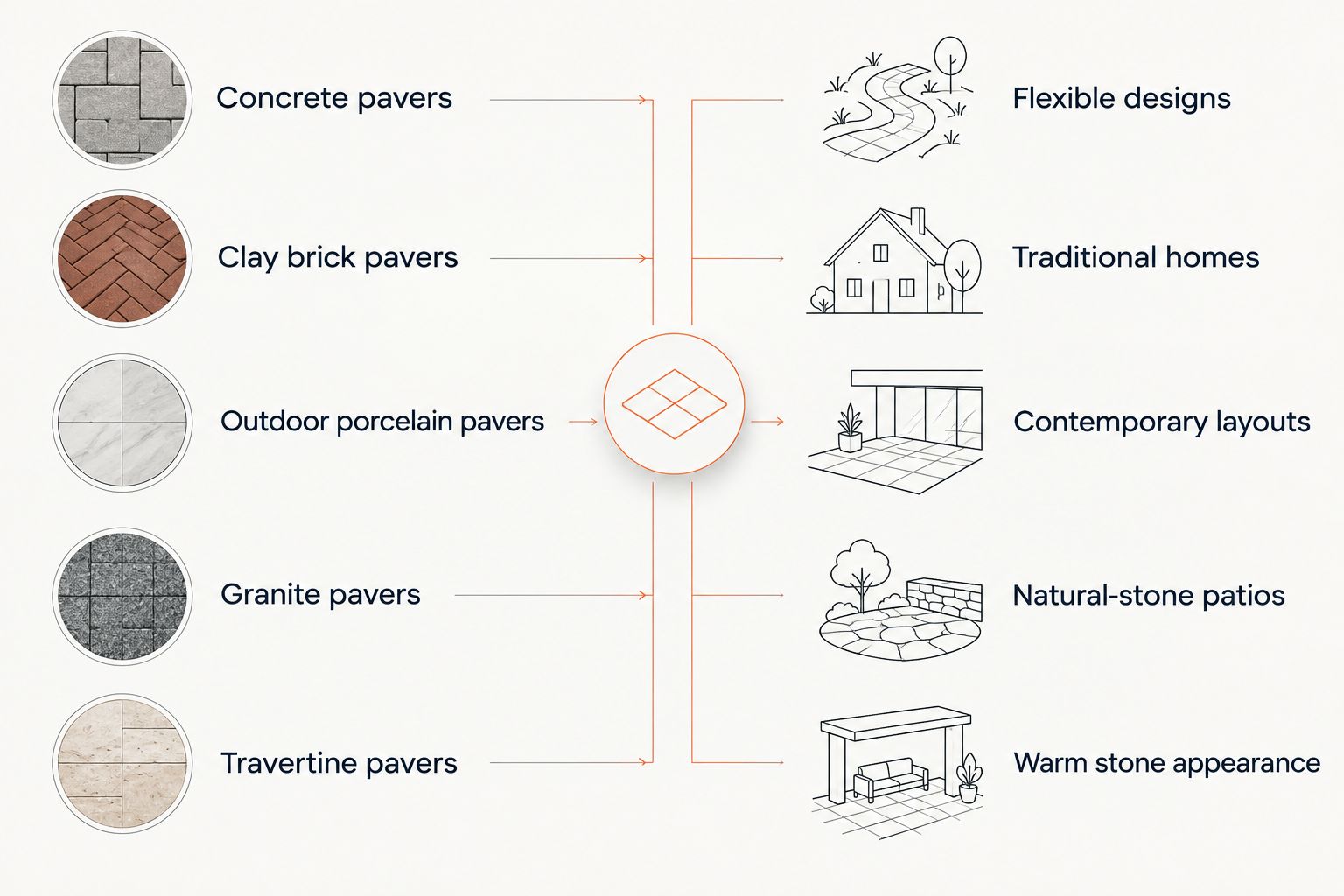
| 1 | Concrete pavers | Flexible residential patio designs | Numerous shapes, finishes, and laying patterns | Surface appearance and maintenance vary by product |
| 2 | Clay brick pavers | Traditional homes and garden patios | Fired-clay character in familiar brick patterns | A narrower visual palette than concrete |
| 3 | Outdoor porcelain pavers | Low water absorption and contemporary layouts | Dense surface with consistent manufactured styling | Requires product-specific support and installation details |
| 4 | Granite pavers | Natural-stone patios with a textured finish | Natural mineral variation and a hard wearing surface | Finish selection and handling need attention |
| 5 | Travertine pavers | Patios with a warm natural-stone appearance | Distinctive pores and stone variation | Cleaning sensitivity and exterior suitability need checking |
These are use-case rankings for 2026, not claims that every product within one material category outperforms every alternative. A well-specified clay or porcelain patio is a better choice than concrete selected without regard to the site.
1. Concrete pavers: best patio pavers for flexible designs
Concrete pavers are manufactured units used to create an interlocking paved surface. Their range of shapes, colors, and textures makes them the strongest starting point when you have not settled on a specific architectural style.
Concrete pavers also suit layouts that need borders, curves, or changes in pattern. For a sand-set installation, individual units can be lifted for repairs, although matching replacement units depends on the product and retained spares.
Concrete pavers pros:
- Broad choice of formats and surface textures.
- Patterns can define dining and walking areas.
- Individual units are replaceable in suitable installations.
Concrete pavers cons:
- Stains, weathering, and efflorescence can affect appearance.
- Joint material and edge restraint still need attention.
- Color and texture vary between product lines.
Best for: Homeowners who want design choices without committing to natural stone or a traditional brick appearance.
Ask to see the chosen concrete paver in daylight and when wet. Evaluate the actual finish rather than treating a catalog photograph as a reliable color reference.
Verdict: Buy concrete pavers as the default shortlist choice for a residential patio.
2. Clay brick pavers: best patio pavers for traditional character
Clay brick pavers create a traditional surface using units manufactured for paving. Choose paving brick rather than assuming brick intended for a wall is suitable underfoot.
Clay works especially well when you want the laying pattern to provide visual interest. Running bond, basketweave, and herringbone produce different effects without introducing several competing materials.
Clay brick pavers pros:
- Fired-clay appearance suits traditional garden settings.
- Familiar patterns give a small material palette variety.
- Individual units can be replaced in sand-set installations.
Clay brick pavers cons:
- Color and format choices are more constrained than concrete.
- Texture and dimensional variation require attention during selection.
- Exterior exposure suitability must match the selected brick.
Best for: Homeowners who prefer a brick patio that complements traditional architecture or established planting beds.
For your 2026 shortlist, compare a small laid-out sample rather than a single brick. Mortar joints, sand joints, borders, and pattern direction change the finished appearance substantially.
Verdict: Buy clay brick pavers when traditional character is the priority.
3. Outdoor porcelain pavers: best for low water absorption
Outdoor porcelain pavers offer a dense manufactured surface in stone-look and other finishes. Porcelain tile has water absorption of 0.5% or less under the definition used by ANSI A137.1; that classification does not, by itself, approve a product for every outdoor installation.
Choose a product explicitly intended for the proposed exterior application. Many outdoor paving products use a 20 mm format, but thickness alone does not establish the correct base, support spacing, or load suitability.
Outdoor porcelain pavers pros:
- Low water absorption is a defining material property.
- Manufactured finishes provide a consistent design direction.
- Large formats can reduce the visual frequency of joints.
Outdoor porcelain pavers cons:
- Cutting and handling require appropriate equipment.
- Edges can chip during handling or installation.
- Support and bedding details are product-specific.
Best for: Homeowners seeking a contemporary layout who are prepared to select the installation system alongside the surface.
Do not substitute indoor porcelain tile for an outdoor paving product. Check exterior suitability, wet-use information, and installation instructions for the exact item under consideration.
Verdict: Buy outdoor porcelain pavers when low absorption and a contemporary finish outweigh installation simplicity.
4. Granite pavers: best for textured natural-stone patios
Granite pavers bring natural mineral variation to a patio. The finish deserves as much attention as the stone name: a polished surface and a textured exterior paving finish are not interchangeable choices.
Granite is a hard stone, but hardness does not eliminate the need for a stable base, suitable joints, and drainage. Review several pieces together so the expected variation is clear before installation.
Granite pavers pros:
- Natural mineral patterns give each installation variation.
- Textured finishes suit exterior paving applications.
- Stone formats can complement masonry and planting.
Granite pavers cons:
- Heavy units complicate handling and cutting.
- Appearance varies between pieces and stone sources.
- Finish selection is critical for wet-use areas.
Best for: Homeowners who specifically want natural stone rather than a manufactured stone-look surface.
Ask how the selected granite will be supported, cut, and cleaned. A material sample cannot answer those installation questions.
Verdict: Buy granite pavers when natural-stone character justifies the handling and detailing involved.
5. Travertine pavers: best for warm natural-stone character
Travertine is a naturally porous limestone used in exterior paving products. Its surface cavities and variation are part of its appearance, but the selected finish, filling treatment, and exposure suitability matter.
Do not assume every travertine product is appropriate for a patio exposed to freezing conditions. Request documentation for the actual stone and intended use rather than relying on a general description of travertine.
Travertine pavers pros:
- Natural variation creates a less uniform appearance.
- Warm stone tones suit garden-focused designs.
- Different finishes offer distinct surface character.
Travertine pavers cons:
- Acidic cleaners can damage this calcium-based stone.
- Pores and surface treatments affect upkeep.
- Freeze-thaw suitability requires product-specific verification.
Best for: Homeowners who value travertine’s appearance and accept stone-specific maintenance.
For a Piedmont Triad patio planned in 2026, settle the exposure question before choosing the color blend. Follow the stone supplier’s maintenance guidance rather than applying generic patio-cleaning advice.
Verdict: Hold until the selected travertine’s exterior suitability and care requirements are confirmed.
Plan the patio before ordering pavers
Material selection becomes easier once the site requirements are clear. Garrison’s Landscaping offers patio hardscaping alongside drainage and grading, so homeowners can discuss those connected parts of the project directly with the owner.
Water first
Identify where roof runoff, yard runoff, and patio drainage will go. Do not direct water toward the house or assume that joints between conventional pavers make the finished patio a permeable paving system.
Base second
Ask what base and bedding system the selected paver manufacturer specifies. Soil conditions, excavation, compaction, and edge restraint belong in the installation discussion—not in a last-minute decision after materials arrive.
Layout third
Mark the furniture footprint and walking routes before fixing the patio perimeter. As a residential planning starting point, allow a 36-inch clear walking route, then enlarge it where chairs, doors, or frequent two-way movement require more space; this is not a substitute for applicable accessibility or building requirements.
Finish last
Compare samples outdoors beside your house and existing masonry. Confirm how the chosen surface looks wet, how its texture feels underfoot, and which cleaning products its manufacturer permits.
Discuss your patio project
Talk directly with the owner about residential patio hardscaping, drainage, and grading.
How the patio pavers rank
The ranking prioritizes installation compatibility, wet traction, climate suitability, repairability, maintenance, and layout flexibility. Concrete takes the default position because it offers broad design choices and replaceable units in suitable installations—not because it wins every material comparison.
Clay, porcelain, granite, and travertine each serve a distinct preference. These are material-selection recommendations, not product test results or endorsements of unnamed manufacturers.
Which patio pavers should you choose?
Choose concrete pavers if you want a practical starting point without a fixed material preference. Move clay brick to the top if traditional character drives the design, or outdoor porcelain if low absorption and a contemporary surface matter more.
Choose granite when natural stone is essential. Keep travertine conditional on documented exterior suitability and a maintenance routine you accept.
For a 2026 patio project, Garrison’s Landscaping provides residential hardscaping across the Piedmont Triad, with customers dealing directly with the owner. Discuss the site and intended use before making the final material selection.
FAQ
What are the best pavers for a patio?
Concrete pavers are the best default shortlist choice for a patio because they offer broad design flexibility and replaceable units in suitable installations. Clay brick, outdoor porcelain, granite, and travertine suit more specific appearance or maintenance preferences.
Are porcelain pavers better than concrete pavers?
Outdoor porcelain pavers are better when low water absorption and a contemporary finish are your priorities; concrete pavers are the broader design starting point. Compare the exact products and their installation requirements rather than treating either category as universally better.
Can I use regular bricks for a patio?
Use bricks manufactured and specified for paving rather than assuming wall bricks are suitable. Confirm exterior exposure suitability and the intended installation method for the selected paving brick.
Which patio pavers are safest when wet?
Choose pavers with a finish and documented suitability for the expected wet-use conditions. Material names alone do not establish traction, and algae, dirt, drainage, and cleaning affect the finished surface.
Do patio pavers stop weeds from growing?
Patio pavers do not make an outdoor surface weed-proof. Windblown seeds can establish in accumulated debris at joints, so joint condition and routine cleaning still matter.
Do all patio pavers need sealing?
No, sealing is not a universal requirement for patio pavers. Follow the selected product’s guidance because sealers can change appearance and surface behavior, and some products have different care requirements.
Are pavers automatically a permeable patio surface?
No, a conventional paver patio is not automatically a permeable paving system. Permeable paving depends on compatible units, joints, bedding, base, and site design—not simply visible gaps between pavers.
One last thing
Keep spare pavers from the original installation. A repairable patio is easier to repair when matching units are already on hand; future purchases can differ in shade, texture, or dimensions.
Store the product identification and installation guidance with those spares. That small handover detail helps you choose compatible cleaning products, replacement joint material, and repair methods later.