
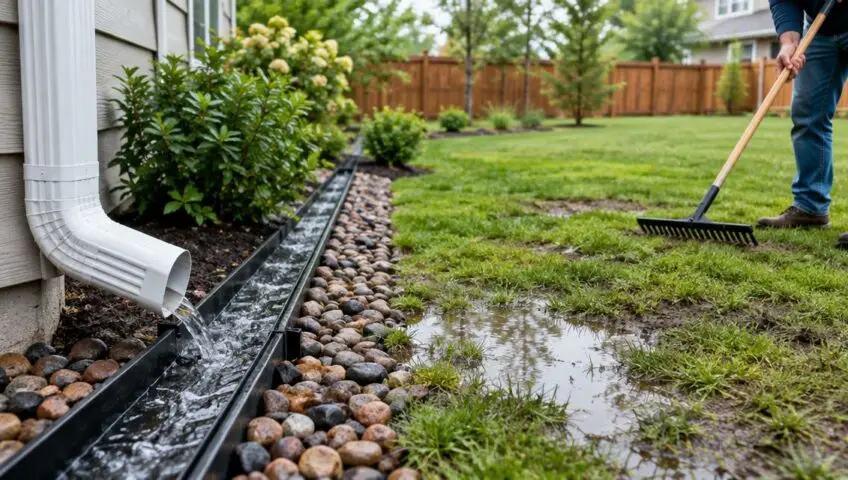
Best overall for surface water flowing toward your home: corrective grading. Best for persistently wet soil: a French drain with a suitable outlet. Best first fix for roof runoff: downspout extensions. The best drainage solutions for yard problems match the source of the water—not just the spot where a puddle appears.
- The best drainage solutions for yard problems depend on water source, ground slope and a suitable discharge point.
- Corrective grading addresses surface flow; French drains address water moving through saturated soil.
- Downspout extensions address concentrated roof runoff, not every wet patch in your lawn.
- Garrison’s Landscaping suits Reidsville homeowners planning yard drainage alongside paver patios or retaining walls.
Why this matters in a Piedmont yard
A soggy patch in Piedmont red clay needs a diagnosis before it needs a pipe. Water running across the surface, roof runoff and water moving through soil call for different fixes. Installing the wrong drain leaves the original problem in place.
For a 2026 project in Reidsville or Rockingham County, decide where the water should go before choosing materials. Garrison’s Landscaping provides residential drainage, grading, paver patios and retaining walls; review the landscaping services when the wet area overlaps a larger yard project.
Start with the source and finish with the outlet. A drain without a suitable discharge point is an unfinished plan.
What makes the best yard drainage solution?
Use these criteria to judge a proposed fix before you compare equipment or materials:
- Water source: Identify whether the water comes from a downspout, an uphill area, paving or saturated ground.
- Ground slope: Check the route water follows, including low spots between the collection point and outlet.
- Discharge location: Require a suitable destination that does not simply move the problem to a neighboring property.
- Soil conditions: Account for clay, compaction and the site's ability to absorb water.
- Nearby structures: Protect foundations, patio bases, retaining walls, utilities and septic components during planning.
- Maintenance access: Make grates, cleanouts and outlets accessible rather than burying the parts you need to inspect.
The best proposal explains those decisions in plain language. A material list alone does not tell you whether the system addresses your yard's problem.
Yard drainage solutions at a glance
| Rank and solution | Best for | Standout feature | Key limitation |
|---|---|---|---|
| 1. Corrective grading | Surface water flowing the wrong way | Changes the ground's drainage direction | Needs workable elevations and a suitable destination |
| 2. French drain | Water moving through saturated soil | Collects subsurface water along a trench | Does not replace surface grading |
| 3. Downspout extensions | Roof runoff beside the house | Moves a concentrated water source | Does not address unrelated groundwater |
| 4. Catch basin and solid pipe | Runoff collecting at a defined low point | Collects surface water through a grate | Grates and sediment need attention |
| 5. Channel drain | Runoff crossing a paved surface | Intercepts water along a narrow line | Needs integration with pavement and an outlet |
| 6. Rain garden | Suitable runoff areas away from structures | Holds runoff temporarily for infiltration | Requires suitable soil and overflow planning |
1. Corrective grading: best yard drainage for wrong-way surface flow
Corrective grading changes the ground so surface water travels toward a planned drainage route rather than collecting against a house, patio or wall. It addresses the shape of the site instead of adding a collection point to an existing depression.
Choose grading first when the ground itself sends runoff where you do not want it. A contractor needs to assess elevations, access and the effect on adjoining areas before removing or adding soil.
Corrective grading pros:
- Addresses the direction of surface runoff.
- Can remove depressions that collect water.
- Fits into patio and retaining wall preparation.
Corrective grading cons:
- Disturbs the lawn and affected landscape beds.
- Cannot create a suitable outlet where site conditions prevent one.
Best for: Homeowners whose surface water follows the wrong route.
For a 2026 patio project, settle grading before the patio layout becomes fixed. Otherwise, a new paved surface can leave you with fewer practical ways to redirect runoff.
Verdict: Buy corrective grading when measured elevations confirm a workable surface route.
2. French drain: best yard drainage for saturated soil
A French drain typically uses perforated pipe within a stone-filled trench to collect water moving through the surrounding soil. Its job differs from a grate that takes in water flowing across the lawn.
Placement matters as much as the pipe. The design needs to account for where water enters the soil, how the trench intercepts it and where collected water discharges.
French drain pros:
- Collects subsurface water along a defined route.
- Keeps the collection system below the finished surface.
- Can complement grading where both problems exist.
French drain cons:
- Is not a substitute for correcting wrong-way surface flow.
- Requires excavation and a suitable discharge arrangement.
Best for: Homeowners with a diagnosed subsurface drainage problem.
Ask how the proposed stone, pipe and separation materials fit your soil conditions. Also ask how the system will be inspected or cleared; a buried installation still needs a maintenance plan.
Verdict: Buy a French drain for subsurface water—not merely because the lawn feels wet.
3. Downspout extensions: best yard drainage for roof runoff
Downspout extensions move roof water away from its current discharge point. They are the first thing to evaluate when a wet area starts beside a downspout during rain.
An extension can discharge above ground or connect to a properly designed solid-pipe system. Either approach needs a destination that avoids foundations, walking routes and neighboring property.
Downspout extension pros:
- Addresses a visible, concentrated water source.
- Can separate roof runoff from a problem bed.
- Makes the route of roof water easier to trace.
Downspout extension cons:
- Does not collect water already moving through soil.
- Can create another wet spot at a poorly chosen outlet.
Best for: Homeowners whose soggy patch begins where roof water lands.
Check the gutter and downspout before planning yard excavation. An overflowing gutter or disconnected fitting needs attention even if a yard drain is also necessary.
Verdict: Buy an extension when roof runoff is the cause and the discharge route is suitable.
4. Catch basin and solid pipe: best yard drainage for a low spot
A catch basin collects surface runoff through a grate and directs it into connected pipe. It suits a defined collection point where water can reach the inlet and then leave through a planned outlet.
The grate is only the entrance. Pipe routing, elevation, sediment access and discharge determine whether the rest of the system works.
Catch basin pros:
- Collects visible surface runoff at a specific point.
- Gives you an accessible inlet to inspect.
- Can connect a low area to a separate discharge location.
Catch basin cons:
- Leaves and sediment can obstruct the inlet.
- Surrounding ground must direct water toward the grate.
Best for: Homeowners with a distinct surface-water collection point.
Ask what happens when runoff exceeds the inlet's capacity or debris covers the grate. The surrounding grading should have an intentional overflow route, not an accidental route toward the house.
Verdict: Buy a catch basin when surface water can reach it and the pipe has somewhere suitable to discharge.
5. Channel drain: best yard drainage for paved runoff
A channel drain uses a long, narrow grated inlet to intercept water crossing a paved surface. It is useful where runoff follows a line across a driveway, walkway or patio edge.
Plan it alongside the paving elevations. A channel placed beside the actual flow path leaves water free to bypass it.
Channel drain pros:
- Collects runoff across a wider line than a point inlet.
- Fits defined transitions between paved areas.
- Can be planned into new hardscape construction.
Channel drain cons:
- Retrofitting can require cutting or removing existing pavement.
- The grate and outlet need ongoing inspection.
Best for: Homeowners managing water crossing a paved surface.
For a 2026 paver patio, discuss surface slope, the channel location and the discharge route together. Choosing the paver pattern first does not resolve where the water goes.
Verdict: Buy a channel drain where a paved flow path needs interception.
6. Rain garden: best yard drainage for suitable infiltration areas
A rain garden is a planted depression designed to receive runoff and let it soak into the ground. It is not simply a wet flower bed or a hole filled with moisture-tolerant plants.
The location needs an infiltration assessment, separation from vulnerable structures and a planned overflow route. Piedmont clay makes those checks especially relevant before you direct more water into one spot.
Rain garden pros:
- Combines runoff management with planting.
- Can keep some runoff within the landscape.
- Provides an intentional receiving area where conditions suit infiltration.
Rain garden cons:
- Poor infiltration can leave persistent standing water.
- Planting and sediment management still require care.
Best for: Homeowners with a suitable infiltration area away from structures.
Do not use a rain garden as the default answer to water beside a foundation. Confirm the location and soil performance before selecting plants.
Verdict: Hold until infiltration and overflow have been assessed.
How these drainage solutions are ranked
The ranking starts with correcting surface flow, then separates subsurface collection, roof runoff, point collection, paved runoff and infiltration. It ranks distinct uses rather than claiming one installation fixes every yard.
Grading ranks first only when surface slope causes the problem. A downspout extension moves ahead of it when roof discharge is the source; a French drain takes priority when the diagnosis identifies subsurface water.
What to check before requesting an estimate
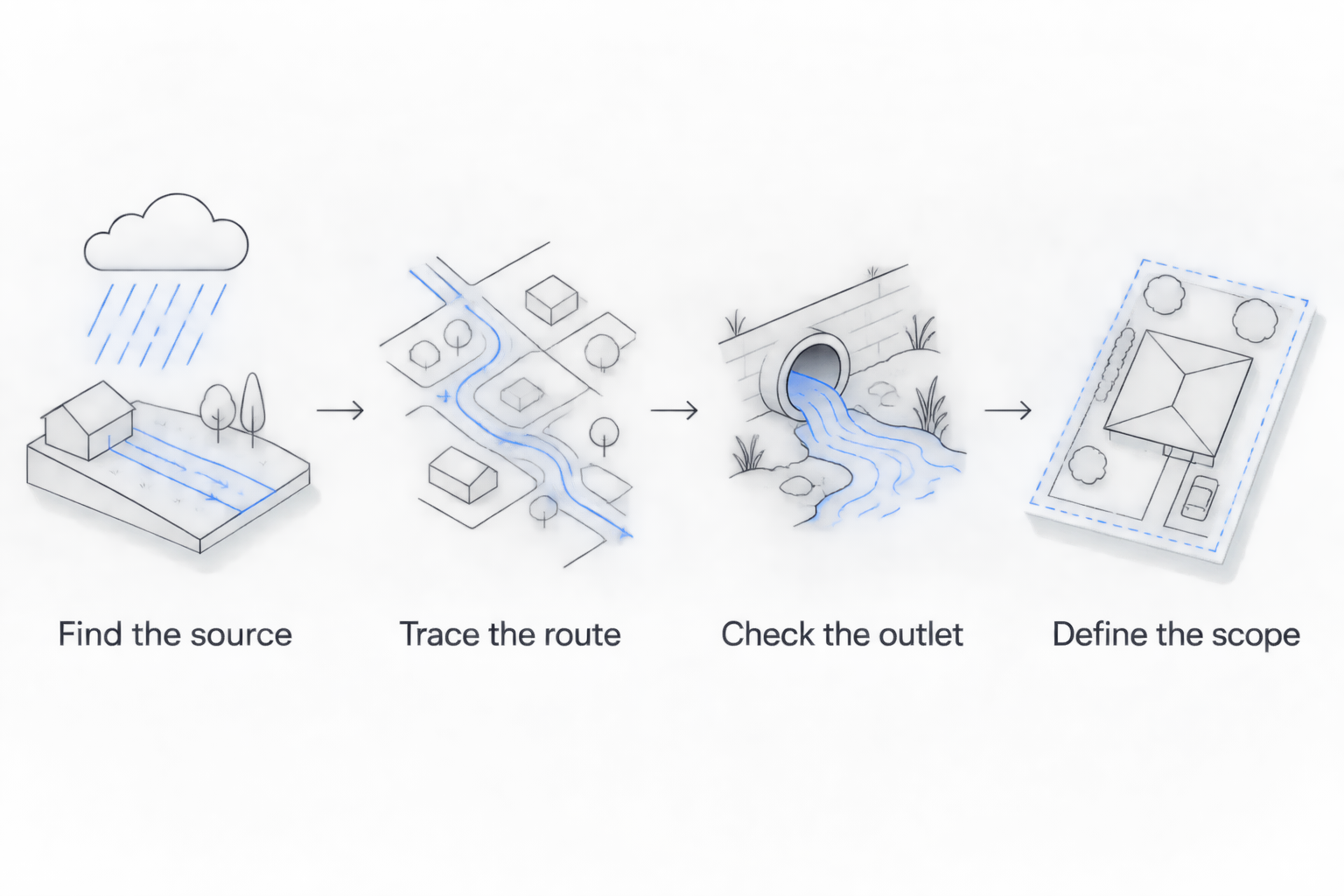
For your 2026 drainage estimate, organize the problem around these steps:
- Find the source. Watch where water enters the wet area during rain, without entering floodwater or unsafe ground.
- Trace the route. Follow visible surface flow and note where it changes direction.
- Check the outlet. Identify the proposed destination and any property or access constraints.
- Define the scope. Include affected patios, walls, beds and lawn restoration in the discussion.
Take 3 photos: the source, the wet area and the apparent discharge route. Photograph the wet area from 2 viewpoints so the contractor can relate it to the house and nearby hardscape. These are preparation steps, not a substitute for an on-site assessment.
Request 1 written scope that describes collection, discharge and disturbed-area restoration. Ask who handles utility locating, whether approvals apply and what maintenance the finished system requires.
Garrison’s Landscaping handles residential yard drainage and grading, with homeowners dealing directly with the owner. When you request a drainage estimate, explain whether you are fixing an existing wet spot or preparing for a patio or retaining wall.
What changes a drainage project quote?
Site access, excavation, drainage design and materials all affect the work. A narrow route to the backyard changes equipment access; existing paving, roots and utilities affect where excavation can happen.
The discharge distance and outlet construction matter too. If the project includes a retaining wall, wall height and the complete wall scope need separate attention rather than being treated as incidental drainage work.
Compare 2026 proposals by scope, not just the final figure. Confirm what each includes for removed materials, soil replacement, lawn repair, paving repair and cleanup.
Which yard drainage solution should you choose?
Choose corrective grading as the default only when the site's surface slope is the cause. Choose downspout extensions for concentrated roof runoff, a French drain for diagnosed subsurface water, and a catch basin or channel drain for the surface flow each is designed to collect.
Garrison’s Landscaping is a fit for Reidsville homeowners planning yard drainage alongside paver patios or retaining walls. The company serves homeowners, not builders or contractors, and does not provide mowing or yard treatments.
FAQ
What’s the best drainage solution for a soggy yard in Reidsville?
The best solution depends on the water source and a suitable discharge route. Corrective grading addresses wrong-way surface flow, French drains collect subsurface water, and downspout extensions redirect roof runoff.
Is a French drain better than a catch basin?
A French drain is better for collecting subsurface water; a catch basin collects surface runoff through a grate. Choose between them by identifying how water reaches the wet area.
Will adding gravel fix a muddy yard?
Gravel alone does not establish a drainage route or correct the ground’s slope. Diagnose the water source and outlet before covering a wet area.
Can I drain water onto my neighbor’s property?
Do not design a system that simply transfers your drainage problem to a neighbor. Have the proposed discharge location checked against site conditions and applicable local requirements.
How much does yard drainage work cost?
Yard drainage needs a site-specific quote based on access, excavation, collection method, pipe routing, materials and restoration. Include patio work, retaining wall height and other connected work when comparing scopes.
Should drainage be installed before a paver patio?
Resolve drainage design before installing a paver patio. Plan finished elevations, surface flow and any required collection system together so the patio does not obstruct the intended route.
What should I send with a drainage estimate request?
Send your location, photos showing the source and wet area, and a description of when water appears. Tell the contractor about nearby patios, retaining walls, downspouts and any planned yard construction.
One last thing
Before you approve a 2026 drainage plan, ask: Where does the water go if the inlet blocks? A pipe route answers how the system works normally; an overflow route addresses what happens when debris or heavy runoff interrupts that plan. Ask the contractor to show you both on the ground.
Related guides
- Best retaining wall materials for NC yards
- Best pavers for a patio
- Best plants for clay soil in North Carolina