
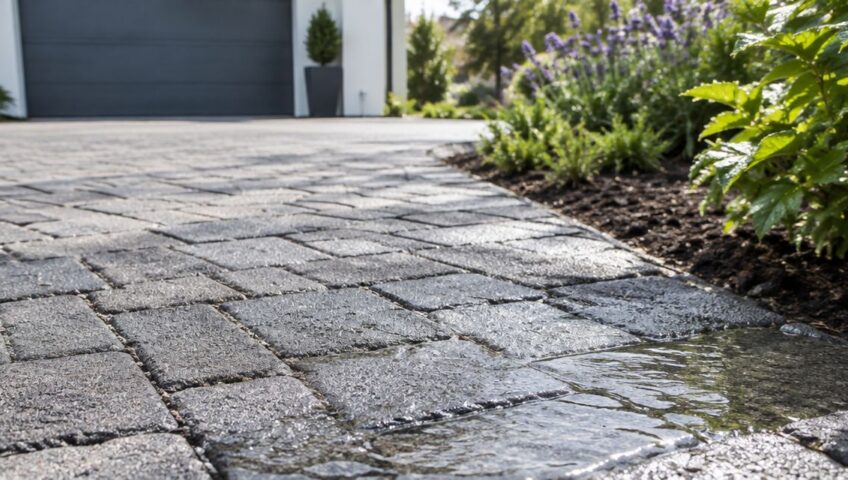
Best overall: permeable interlocking concrete pavers. Best for a traditional brick look: permeable clay pavers. Best for occasional vehicle access: gravel-filled concrete grids. The best permeable pavers for drainage in a Reidsville yard depend on the stone base, soil and discharge route—not just the surface you choose for a 2026 project.
- Permeable interlocking concrete pavers are the best permeable pavers for drainage on residential patios and walkways.
- Permeable clay pavers suit homeowners who prefer brick; specify a complete permeable paving system.
- Gravel-filled concrete grids suit utility access better than patios with dining furniture.
- Piedmont red clay makes soil assessment, water storage and an approved outlet central to drainage design.
Why this matters
Water passing between pavers has not disappeared. It still needs somewhere to collect, soak into suitable soil or leave through a designed outlet. In Piedmont red clay, choosing an attractive paving unit without resolving that next step leaves the drainage problem unfinished.
Garrison’s Landscaping is best for Reidsville homeowners who want residential paver patios considered alongside drainage and grading. Its landscaping and hardscaping services include those connected parts of the project. For your 2026 estimate, ask for an explanation of the whole water path before choosing colors or patterns.
What makes the best permeable pavers for drainage?
Judge the complete installation against these criteria, in this order:
- Water destination: Identify where water goes after entering the pavement, including when the underlying soil is saturated.
- Base design: Specify compatible, open-graded aggregate, excavation and compaction rather than treating the base as ordinary patio preparation.
- Surface suitability: Match the paving system to walking, furniture, vehicles and accessibility needs.
- Sediment control: Keep loose soil and mulch from washing into the openings and reducing infiltration.
- Maintenance access: Choose a surface you can keep clear and a drainage system whose outlets remain accessible.
- Site constraints: Consider foundations, slopes, utilities, retaining walls and equipment access before committing to permeable paving.
These criteria put concrete pavers first for a typical residential patio—not because concrete itself absorbs the rain, but because purpose-made permeable systems combine usable paving surfaces with drainage openings.
Permeable paving options at a glance
| Rank and option | Best for | Standout feature | Key limitation |
|---|---|---|---|
| 1. Permeable interlocking concrete pavers | Everyday patios and walkways | Solid paving units with aggregate-filled drainage joints | Joints clog when sediment reaches them |
| 2. Permeable clay pavers | Traditional brick-style outdoor spaces | Clay appearance in a purpose-designed permeable assembly | Ordinary tightly jointed brick paving is not equivalent |
| 3. Gravel-filled concrete grids | Occasional vehicle access and utility areas | Concrete cells retain aggregate infill | Open cells are less suitable for small furniture feet |
| 4. Grass-filled paving grids | Infrequent access where grass is the priority | Reinforced cells support a vegetated surface | Living grass needs suitable growing conditions and care |
None of these options fixes poor grading by itself. A surface that accepts rainfall still needs a base and outlet arrangement suited to its location.
1. Permeable concrete pavers: best for patios and walkways
Permeable interlocking concrete pavement uses solid paving units separated by designed openings. Water moves through aggregate-filled joints into an open-graded stone base below. The joints, bedding and base work together; the paver is only the visible component.
Best for: Homeowners planning an everyday patio, front walk or outdoor sitting area where drainage and a firm walking surface both matter.
For a Reidsville patio, start here if you want a conventional paved appearance. Ask the installer to show the proposed joint opening and finish so you can assess furniture placement, footwear and ease of movement.
Permeable concrete paver pros:
- Solid units provide a practical surface for ordinary patio use.
- Individual units can be lifted for localized repairs.
- Purpose-made systems define compatible joints and installation requirements.
Permeable concrete paver cons:
- Sediment can obstruct the drainage joints.
- Excavation and base requirements complicate a straightforward surface replacement.
- Tight joints or unsuitable joint filler defeat the intended drainage approach.
Do not accept standard patio pavers described as permeable simply because gaps are visible. Ask for the specified paving system and installation details.
Verdict: Buy for a residential patio or walkway when the site assessment supports permeable paving.
2. Permeable clay pavers: best for a traditional brick look
Permeable clay paving combines clay units with drainage openings and a compatible aggregate assembly. It suits a homeowner who wants a brick appearance without directing all rainfall across a sealed surface.
Best for: Front walks, courtyard-style patios and garden paths where the appearance of clay is a priority.
The important distinction is between a permeable clay paving system and ordinary brick installed with tight joints or mortar. Specify the intended assembly, not just the material name. In a 2026 proposal, the words brick patio alone do not explain drainage performance.
Permeable clay paver pros:
- Offers the character of clay paving.
- Individual units allow localized replacement.
- Provides an alternative to concrete units within a permeable design.
Permeable clay paver cons:
- Not every clay paving unit is intended for a permeable installation.
- Uneven installation affects walking comfort and furniture stability.
- Joints still need protection from soil and organic debris.
Compare a physical sample with the proposed joint material. Color and texture matter, but neither tells you whether the base can store water or whether the site needs an underdrain.
Verdict: Buy when the brick appearance matters enough to guide material selection.
3. Gravel-filled concrete grids: best for utility access
Concrete grid units create a cellular surface filled with aggregate. The cells retain the infill while openings allow water into the supporting assembly. This is a utility-oriented choice rather than a direct substitute for a closely jointed patio.
Best for: Occasional vehicle access, equipment routes and secondary parking areas designed for the expected loads.
Tell the installer what will use the surface. A garden cart route and a vehicle access lane need different load considerations, even when the finished grid looks similar.
Gravel-filled concrete grid pros:
- Keeps aggregate organized within a defined cellular pattern.
- Provides open areas for water entry.
- Fits utilitarian areas where a formal patio finish is unnecessary.
Gravel-filled concrete grid cons:
- Small chair legs and narrow wheels can catch in open cells.
- Loose infill needs attention if it migrates or settles.
- Vehicle use still requires an appropriately designed supporting base.
Keep grids out of the main dining area unless you have checked how your furniture sits on the actual surface. A sample panel is more useful than a distant photograph.
Verdict: Buy for suitable utility access; skip as the default dining-patio surface.
4. Grass-filled paving grids: best for infrequent access
Grass-filled grids reinforce a vegetated surface while leaving cells available for growing medium and grass. They fit a different brief from a paved patio: preserving a grassy appearance where occasional access is needed.
Best for: Infrequently used access areas where you accept lawn care and seasonal changes in appearance.
Grass is not a permanent green filler. It needs appropriate sunlight, soil conditions, moisture and recovery from traffic. Repeated parking or turning places demands on the turf as well as the grid.
Grass-filled paving grid pros:
- Preserves a vegetated appearance.
- Defines an access surface without a continuous paved finish.
- Provides openings for water entry when correctly designed and maintained.
Grass-filled paving grid cons:
- Grass requires ongoing care.
- Shade, wear and unsuitable growing conditions affect coverage.
- The cellular surface is less useful for everyday patio furniture.
This is a material comparison, not an offer of turf maintenance. Garrison’s Landscaping does not provide mowing or yard treatments, so plan ongoing lawn care separately.
Verdict: Hold unless infrequent access and a living grass surface are clear priorities.
How permeable paving needs to work in Piedmont red clay
A permeable patio is a water-management assembly. Its design needs to connect surface entry, stone storage, soil infiltration and an approved outlet where drainage discharge is required. Leaving any connection unexplained is a reason to question the proposal.
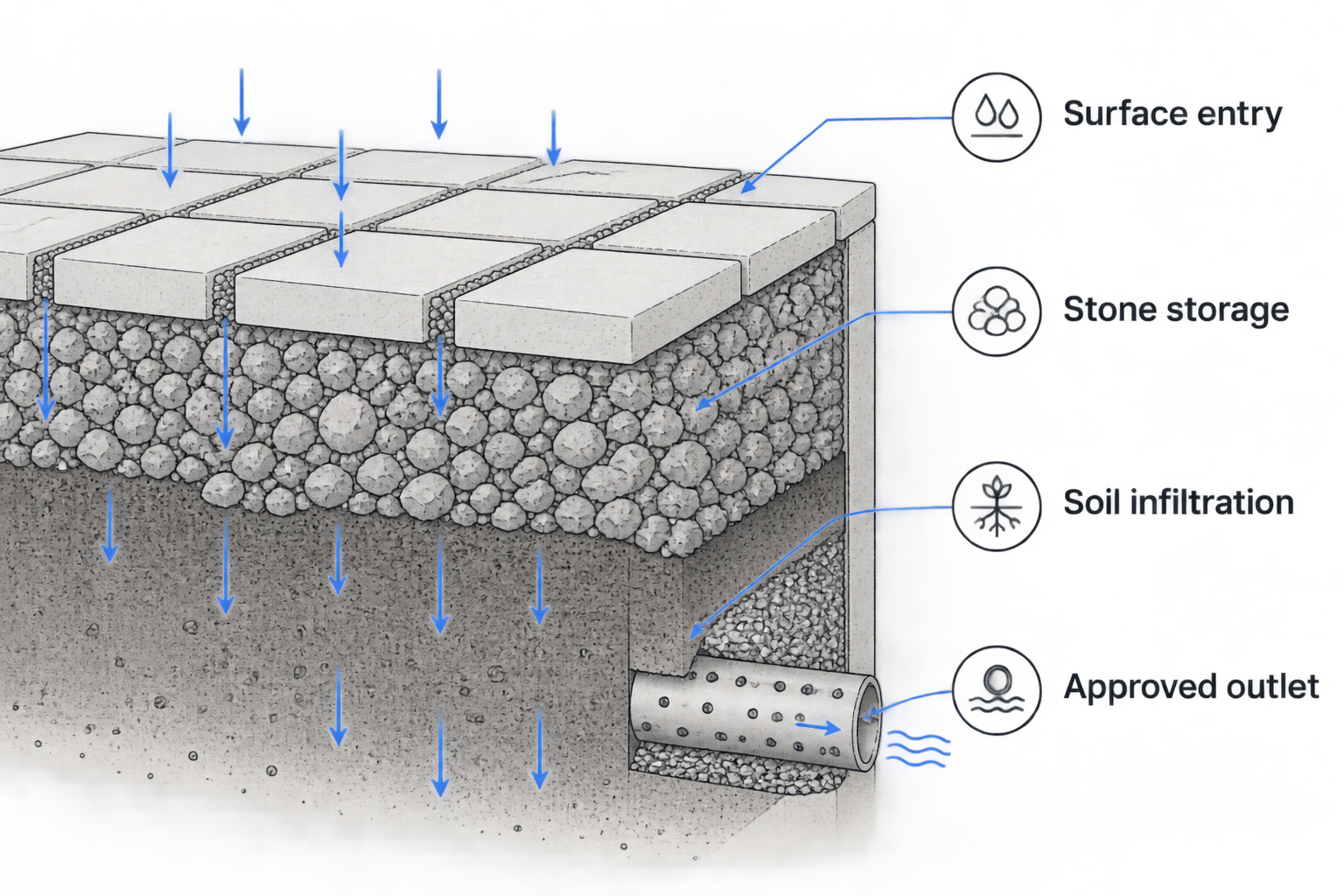
Clay soil does not automatically rule out permeable paving. It does make the soil assessment important: a design must account for how quickly the underlying ground accepts water and how the stored water drains down between storms.
An underdrain can carry water from the stone reservoir to a suitable discharge point. It is not permission to send water toward a neighbor, foundation or unstable slope. Ask how the proposed outlet is permitted and whether local review applies.
For a 2026 project beside a retaining wall, coordinate the wall and pavement drainage designs. Water entering a patio should not be casually directed behind the wall. If your main problem is roof runoff or uphill water crossing the yard, compare drainage solutions for a soggy yard before deciding that permeable paving is the answer.
What to ask before approving an estimate
A useful estimate explains preparation and limits, not just the finished square footage. Ask these questions during the site visit:
- What feeds this area? Separate rainfall landing on the patio from downspouts, uphill runoff and overflowing beds.
- How will the soil be assessed? Ask what the findings mean for infiltration, storage and drainage discharge.
- What gets excavated? Identify removal, disposal, unsuitable soil and any access restrictions.
- What is the base specification? Request the aggregate types, proposed layer depths and installation approach in writing.
- Where does excess water go? Identify the overflow route as well as any underdrain outlet.
- How is the surface maintained? Confirm joint-cleaning methods and how to avoid introducing sediment.
- What is excluded? Clarify utility relocation, wall work, planting restoration and other work outside the paving scope.
Project cost changes with access, excavation, drainage, materials and scope. If a retaining wall is involved, wall height and construction requirements also change the quote. Compare proposals against the same preparation and drainage requirements rather than treating all paved areas as equivalent.
For your 2026 estimate request, include photographs taken during rain, the intended use and whether you plan a nearby wall. Garrison’s Landscaping serves homeowners directly; explain the drainage problem and the outdoor space you want to use, not just your preferred paver color.
Request a patio and drainage estimate
Describe your Reidsville or Rockingham County yard, intended patio use and existing water problems.
How these options rank
This ranking prioritizes everyday residential use, a practical walking surface, drainage design and maintenance demands. It compares paving categories—not measured infiltration results from installations in your yard.
Concrete pavers take the default position because they suit a conventional patio brief. Clay pavers move ahead when brick appearance is the deciding factor. Gravel and grass grids belong to access-area decisions, where furniture comfort matters less than the intended surface use.
Which permeable pavers should you choose?
Choose permeable interlocking concrete pavers for a typical Reidsville patio, provided the drainage design fits the site. Choose permeable clay when you specifically want brick. Reserve grid systems for access areas rather than treating them as interchangeable patio finishes.
For a 2026 build, approve the water-management plan before the surface selection. If infiltration, storage or a lawful discharge route cannot be resolved, conventional paving with properly designed grading and drainage deserves consideration instead.
FAQ
What’s the best permeable paver for a backyard patio?
Permeable interlocking concrete pavers are the default choice for an everyday backyard patio. Their solid units suit walking and furniture, while designed aggregate-filled joints admit water into the base.
Do permeable pavers work in North Carolina clay soil?
Permeable paving can be designed for clay soil, but the soil assessment determines the drainage approach. A stone reservoir, underdrain or other site-specific provisions can be necessary where infiltration is limited.
Are permeable pavers better than a French drain?
Permeable pavers and French drains solve different parts of a drainage problem. Permeable paving accepts water through a usable surface; a French drain intercepts and conveys subsurface water, and some projects need both approaches.
Can I make regular patio pavers permeable by widening the joints?
Wider joints alone do not create a properly designed permeable pavement. The paving units, joint aggregate, bedding, stone base and drainage arrangement must function as a compatible system.
Do permeable pavers need maintenance?
Yes, permeable paving needs maintenance to keep its openings clear. Keep soil and mulch off the surface, remove debris and follow the paving system’s cleaning instructions.
What changes the cost of a permeable patio installation?
Access, excavation, disposal, base preparation, drainage and material selection change the quote. Retaining walls, wall height and the amount of surrounding restoration also affect the overall project scope.
Who should I contact about a permeable patio in Reidsville?
Garrison’s Landscaping is a residential landscaping and hardscaping company in Reidsville that offers paver patios, drainage and grading. Describe the intended patio use and current water problems when requesting an estimate.
One last thing
Look uphill before looking down at the pavers. Bare soil, overflowing beds and concentrated runoff can carry sediment onto a new surface and clog its openings. Address those sources in the project scope; choosing a different paver does not remove them.
Related guides
- Best pavers for a patio
- Best retaining wall materials for NC yards
- Best plants for clay soil in North Carolina