
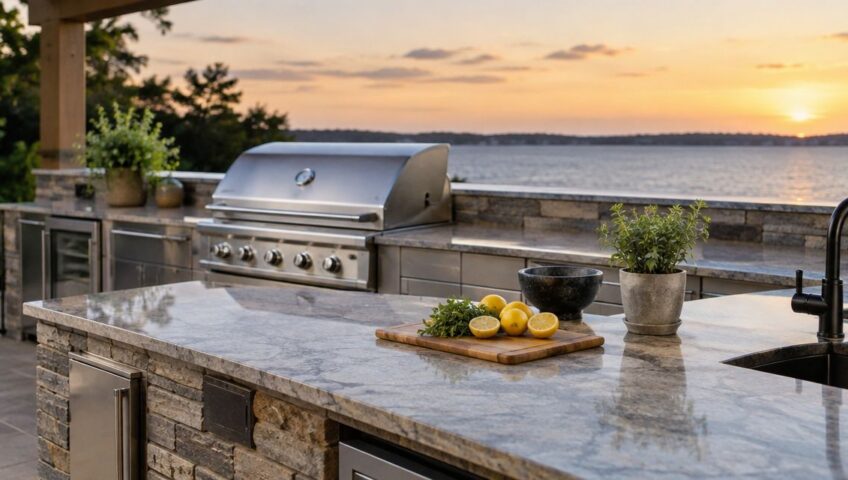
Best overall: granite. Best for low absorption: outdoor-approved porcelain slabs. Best for a working prep station: stainless steel. The best outdoor kitchen countertop materials for Reidsville homeowners match the weather exposure, cabinet support and cleanup you expect—not just the sample you like.
- Granite leads the best outdoor kitchen countertop materials for homeowners who want natural stone and accept periodic care.
- Outdoor-approved porcelain slabs suit homeowners who prioritize low absorption; exposed edges need careful detailing.
- Stainless steel suits prep stations, concrete suits custom shapes, and outdoor-rated tile suits modular designs.
- Garrison’s Landscaping handles residential outdoor kitchens; plan the patio, drainage and countertop support together.
Why this matters in Reidsville
An outdoor countertop sits on a structure, and that structure sits on your yard. In Rockingham County, Piedmont red clay and water collecting around a patio make the foundation and drainage part of the kitchen decision—not separate finishing details.
Garrison’s Landscaping is a fit for Reidsville homeowners planning an outdoor kitchen alongside residential hardscape work. Review the landscaping and hardscaping services before defining the project, especially when the kitchen also needs a paver patio, grading or a retaining wall.
For a 2026 project, choose the countertop before finalizing the base and appliance openings. Different materials need different support, fabrication and edge details. A finished patio does not resolve those questions by itself.
What makes the best outdoor kitchen countertop materials?
Use these criteria before comparing colors:
- Outdoor suitability: Confirm that the exact material, finish and installation system are intended for exterior exposure. An indoor showroom sample is not enough.
- Water management: Check absorption, joints, cutouts and the path water takes around the kitchen.
- Heat and sunlight: Separate resistance to weather from resistance to a hot pan. Use trivets and follow appliance clearances.
- Structural support: Match the base, overhangs and reinforcement to the countertop fabricator’s requirements.
- Maintenance: Decide whether you will maintain sealer, clean grout or accept scratches and staining.
- Repair limitations: Ask what happens if an edge chips, a seam opens or a section needs replacement.
Outdoor countertop materials at a glance
| Material | Best for | Standout feature | Key limitation |
|---|---|---|---|
| Granite | A natural-stone countertop for everyday use | Durable stone with varied patterns | Absorption and sealing needs vary by slab |
| Outdoor-approved porcelain slabs | Low-absorption surfaces | Dense surface with stone-look options | Exposed edges and cutouts need careful fabrication |
| Stainless steel | Dedicated food-prep stations | Nonporous surface with fabricated sink options | Shows scratches and heats in direct sun |
| Concrete | Custom shapes and integrated details | Cast-to-shape flexibility | Cracking, staining and sealer upkeep |
| Outdoor-rated tile | Modular layouts and patterned finishes | Individual tiles form a customizable surface | Grout joints and exterior assembly details |
1. Granite: best outdoor countertop for natural-stone appeal
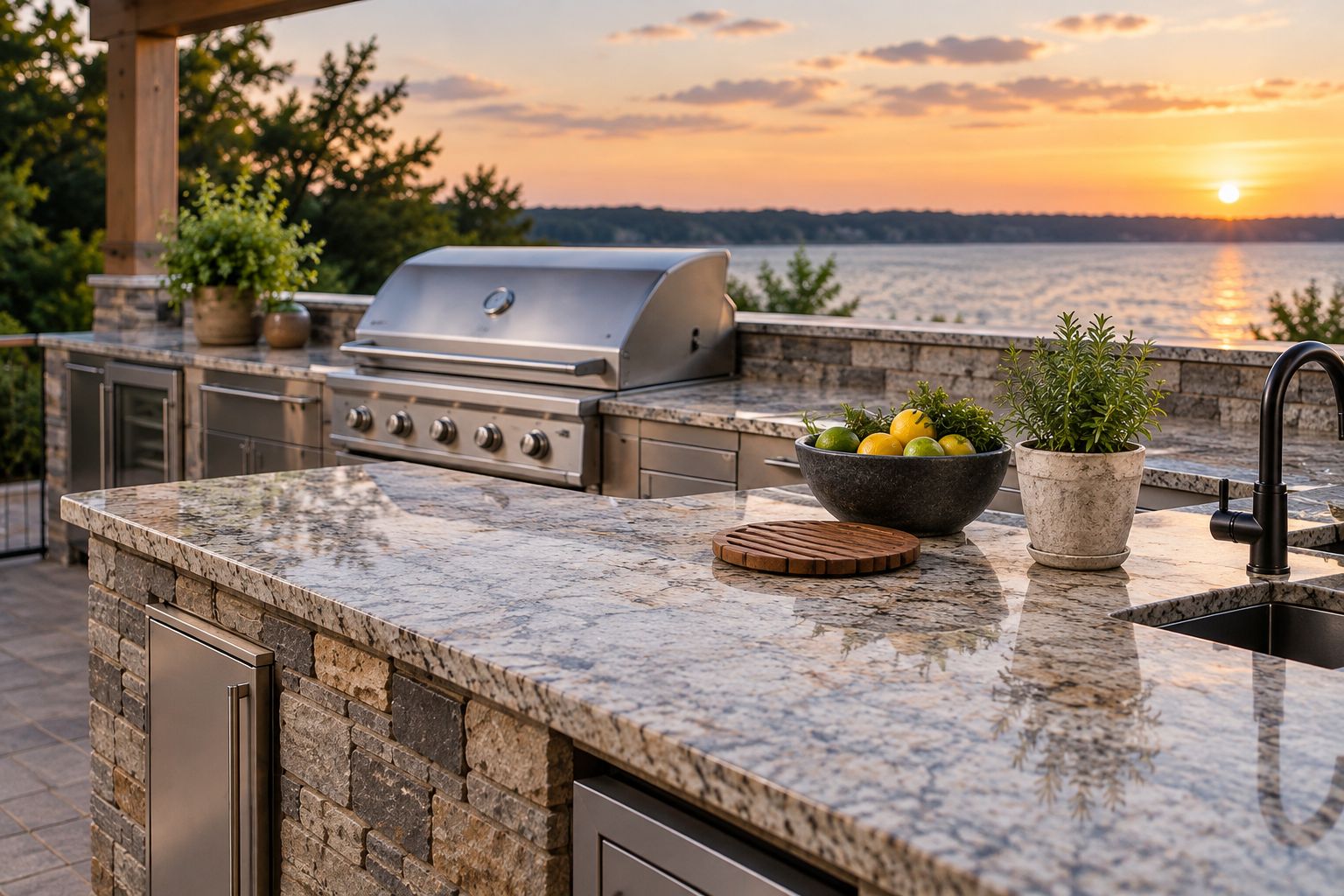
Granite is the default recommendation when you want natural stone and accept that care requirements vary. Choose the actual slab, not just a color name, and have the fabricator confirm its suitability for your outdoor location.
A simple edge and a supported layout keep the design focused on usable counter space. Around a grill, granite does not remove the need for the appliance manufacturer’s clearances or a landing area for hot cookware.
Granite pros:
- Natural variation gives each slab a distinct appearance.
- The stone handles ordinary outdoor countertop use well when properly selected and installed.
- A fabricated slab provides a continuous work area with fewer joints than tile.
Granite cons:
- Some slabs need sealing; the schedule depends on the stone, exposure and product instructions.
- Edges can chip, and unsupported areas need careful design.
- Dark surfaces become hot in direct sunlight.
Best for: Homeowners who want a natural-stone centerpiece and will follow stone-specific care instructions.
Verdict: Buy granite as the default choice, after confirming the slab and support plan.
2. Porcelain slabs: best outdoor countertop for low absorption
Outdoor-approved porcelain slabs suit homeowners who want a dense surface without natural stone’s variable absorption. Confirm exterior approval for the exact slab; the word porcelain alone does not establish whether the entire installation is suitable.
Fabrication matters most around edges, corners and appliance cutouts. Ask how the installer will support the slab and detail any built-up edge, rather than judging the finished thickness by appearance alone.
Porcelain slab pros:
- Low absorption simplifies routine spill cleanup.
- Exterior-approved options provide stone-look finishes without being natural stone.
- Large slabs reduce the number of surface joints compared with small-format tile.
Porcelain slab cons:
- Sharp impacts can chip exposed edges.
- Edge appearance and repairs differ from solid natural stone.
- Fabrication and handling require experience with the selected slab system.
Best for: Homeowners prioritizing low absorption who can protect exposed edges and use an experienced fabricator.
For a 2026 selection, get the current exterior-use documentation before approving the slab. Keep that documentation with the installation scope.
Verdict: Buy outdoor-approved porcelain when low absorption matters more than a natural-stone edge.
3. Stainless steel: best outdoor countertop for food preparation
Stainless steel works well as a dedicated preparation surface beside a grill or sink. A fabricator can form edges and integrate a sink, reducing joints in the working area.
It suits a kitchen you intend to use, not a surface you expect to stay visually untouched. Scratches become part of the finish, and direct sunlight makes temperature an important comfort consideration.
Stainless steel pros:
- The nonporous surface is straightforward to clean.
- Fabricated sink and backsplash details can reduce separate joints.
- It does not require stone sealer or grout maintenance.
Stainless steel cons:
- Scratches, fingerprints and water marks remain visible.
- Direct sun makes the surface hot to touch.
- Stainless steel is not immune to corrosion; material selection and cleaning practices matter.
Best for: Homeowners who want a practical prep station and accept a working-kitchen appearance.
Ask the fabricator to specify the steel, finish and underlying support. Avoid abrasive or chlorine-containing cleaners unless the manufacturer explicitly permits them, and rinse away cleaning residue as directed.
Verdict: Buy stainless steel for a dedicated prep zone; skip it if visible scratches will bother you.
4. Concrete: best outdoor countertop for custom shapes
Concrete gives you flexibility when the countertop needs an unusual shape or a deliberately cast appearance. It is a design choice with maintenance obligations, not a maintenance-free substitute for stone.
Discuss reinforcement, curing, joints and sealing before approving the design. A smooth sample does not tell you how the installed countertop will respond to spills, weather or movement beneath the base.
Concrete pros:
- Casting allows custom shapes and integrated details.
- Color and surface texture can be part of the design.
- The finished appearance suits masonry-heavy outdoor kitchens.
Concrete cons:
- Hairline cracking can occur even with careful construction.
- Unprotected concrete absorbs spills and can stain.
- Sealers require care and must suit exterior countertop use.
Best for: Homeowners who value a custom cast appearance and accept variation, cracking risk and sealer upkeep.
During your 2026 estimate discussions, ask what the proposed sealer protects against and which cleaning products it allows. Also ask how the contractor handles a cosmetic crack versus a structural problem; those are not the same issue.
Verdict: Buy concrete for a specific design goal, not because you expect effortless ownership.
5. Outdoor-rated tile: best outdoor countertop for modular designs
Outdoor-rated tile suits layouts where pattern, replaceable pieces and smaller components matter. Porcelain tile and porcelain slabs are different assemblies: a tiled counter has more joints, and its substrate, waterproofing and edge details determine much of its performance.
Choose the complete exterior system, not individual tiles in isolation. In a Reidsville kitchen exposed to rain and freezing weather, water getting beneath the surface is a construction issue worth resolving before installation.
Outdoor-rated tile pros:
- Smaller pieces allow patterns and flexible layouts.
- Individual damaged tiles can sometimes be replaced without replacing the whole counter.
- Different trim approaches allow customized edges.
Outdoor-rated tile cons:
- Grout joints interrupt the work surface and need cleaning.
- Poor substrate or waterproofing details can lead to failure.
- Matching replacement tile can be difficult later.
Best for: Homeowners who specifically want a tiled appearance and accept grout maintenance.
Ask for tile, mortar, grout and waterproofing products that are compatible with each other and the exterior application. Keep spare matching tile if you choose this route.
Verdict: Buy outdoor-rated tile for its modular design; skip it if a joint-free prep surface is your priority.
Plan the kitchen from the ground up
A countertop selection is incomplete until the site and base support it. Ask Garrison’s Landscaping to discuss the outdoor kitchen as part of the surrounding residential hardscape, including any patio, retaining wall, drainage or grading work.
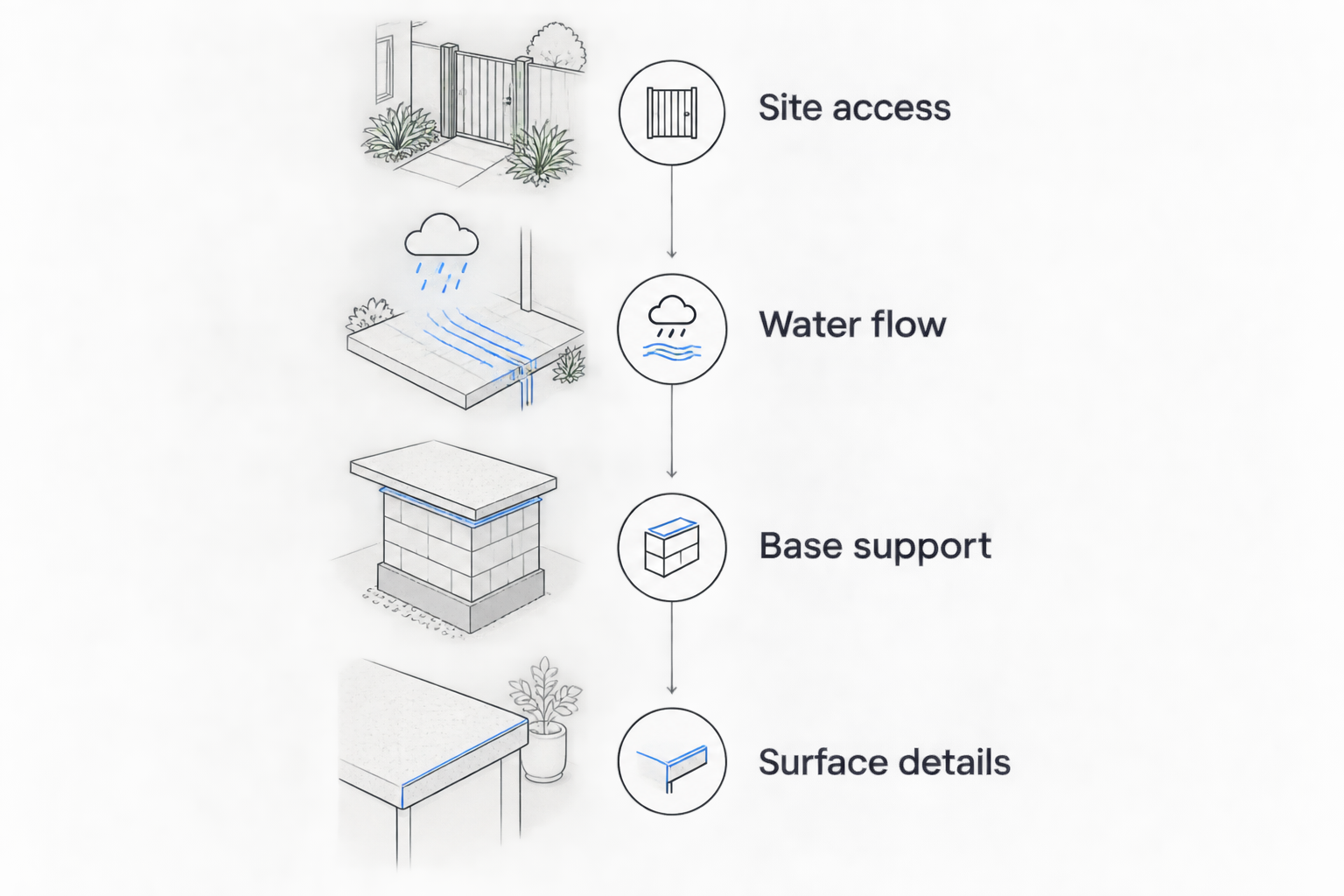
Use this sequence when comparing project scopes:
- Site access: Establish how equipment and materials reach the backyard and what existing surfaces need protection.
- Water flow: Identify where runoff travels and how the kitchen affects drainage across the patio.
- Base support: Coordinate the foundation, cabinet or masonry base, countertop support and appliance openings.
- Surface details: Finalize the material, edges, seams, cutouts and cleaning requirements.
If a retaining wall creates the kitchen’s usable space, include its drainage and structural requirements in the project discussion. Do not treat a wall as decorative edging when it is holding back soil.
What changes an outdoor kitchen quote?
Compare written scopes, not countertop names alone. Two granite proposals do not describe the same project if one includes excavation and drainage while the other assumes a finished, suitable base.
The main scope questions are:
- Access and excavation: What equipment can enter, what must be removed, and where does excavated material go?
- Drainage and grading: Does the yard need changes to keep runoff from collecting around the kitchen?
- Materials and fabrication: Which slab or finish, edge treatment, seams and cutouts are included?
- Wall height: Does creating level space require a retaining wall, and what design or approval requirements apply?
- Full scope: Are demolition, patio work, appliance coordination and cleanup included or excluded?
For your 2026 estimate request, provide the Reidsville or Rockingham County location, backyard access photos, the proposed kitchen area and your preferred material. State whether you also need a patio, wall or drainage work, then request an outdoor kitchen estimate.
How these materials rank
Granite takes the default position for natural-stone appeal and practical everyday use. Porcelain slabs win the low-absorption slot; stainless steel wins for preparation; concrete wins for custom shapes; tile wins for modular design.
The order follows exterior suitability, maintenance, support and repair limitations—not an assumption that every homeowner wants the same finish. Exact product approval and installation details take priority over the material category.
Which countertop should you choose?
Start with granite unless you have a clear reason to choose something else. Move to outdoor-approved porcelain for low absorption, stainless steel for a working prep station, concrete for a custom cast shape or tile for a deliberately jointed design.
For a 2026 outdoor kitchen, settle the site and support questions before signing off on the surface. The countertop and its base need to be designed together.
FAQ
What’s the best outdoor kitchen countertop material in Reidsville?
Granite is the default recommendation for Reidsville homeowners who want natural stone and accept stone-specific care. Confirm the exact slab’s outdoor suitability, support requirements and sealing needs before ordering.
Is porcelain better than granite for an outdoor kitchen?
Outdoor-approved porcelain is better when low absorption is your priority; granite is the choice for a natural-stone surface. Porcelain edges need careful detailing, while granite’s absorption and care requirements vary by slab.
Can I put a hot pan directly on an outdoor countertop?
Use a trivet rather than placing hot cookware directly on an outdoor countertop. Follow the surface manufacturer’s instructions and the grill manufacturer’s clearance requirements.
Does an outdoor granite countertop need sealing?
Some outdoor granite countertops need sealing, but the requirement depends on the specific stone. Ask the fabricator how to assess absorption and follow the chosen sealer’s exterior-use instructions.
Will concrete outdoor countertops crack?
Concrete outdoor countertops can develop cracks even when carefully constructed. Discuss reinforcement, curing, support and how cosmetic or structural cracks will be addressed before installation.
What changes the quote for an outdoor kitchen countertop?
Material, fabrication, cutouts, edges and support change the countertop scope. The overall kitchen quote also depends on access, excavation, drainage, grading, retaining-wall height and surrounding patio work.
Does Garrison’s Landscaping build outdoor kitchens for homeowners?
Garrison’s Landscaping provides residential outdoor kitchen work and related hardscaping. Homeowners deal directly with the owner; the company does not target builders or contractors.
One last thing
Bring photos taken during or just after rain to your estimate discussion. They help show where water collects and travels—details a dry-day visit does not always reveal. Choose the water path before you choose the countertop color.
Related guides
- Best pavers for a patio
- Best retaining wall materials for NC yards
- Best drainage solutions for a soggy yard