
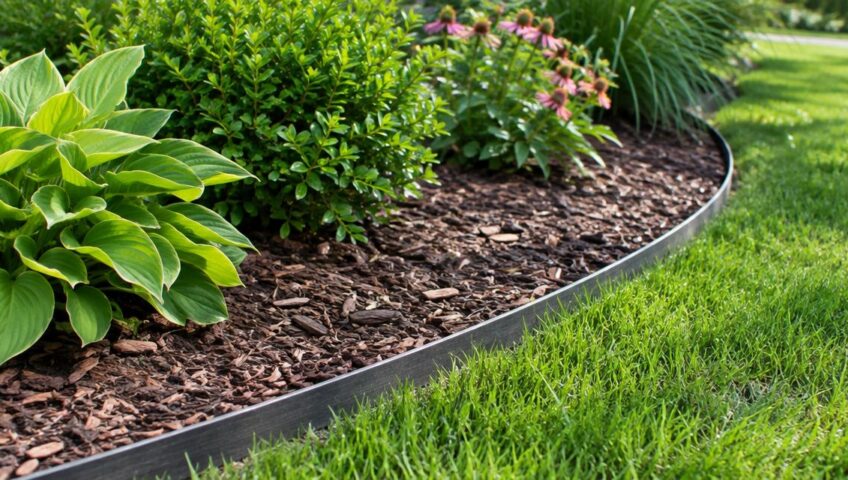
Best overall: steel edging. Best beside a paver patio: concrete pavers. Best for curved beds: aluminum edging. This 2026 guide compares the best landscape bed edging materials for Reidsville and Rockingham County homeowners, including where each works, where it falls short, and what installation needs to address.
- Steel leads the best landscape bed edging materials for a narrow, defined border; exposed edges need careful placement.
- Concrete pavers suit patio-side beds; natural stone suits irregular borders but leaves more joints to manage.
- Aluminum suits curves, while plastic requires secure anchoring and careful backfilling.
- Garrison’s Landscaping handles residential landscape beds, paver patios, retaining walls, drainage, and grading.
- Fix runoff and elevation problems before choosing a decorative landscape border.
Why this matters in Piedmont red clay
Edging separates materials; it does not fix a wet yard or hold back a slope. In Piedmont red clay, a border installed without checking grades can trap water against a bed or interrupt an existing drainage route.
For residential bed work connected to patios, retaining walls, or drainage, Garrison’s Landscaping is a fit for Reidsville homeowners planning those improvements together. The company works directly with homeowners, not builders or contractors.
You can review Garrison’s Landscaping while you plan the broader project. Choose the edge after deciding where water, mulch, soil, and foot traffic need to go—not just which border looks good in a picture.
What makes the best landscape bed edging materials?
Use these criteria to compare a proposed border before approving your 2026 project:
- Separation: The edge should keep mulch, gravel, and adjacent surfaces distinct without creating a maintenance obstacle.
- Shape: Straight runs, broad curves, and tight bends call for different materials and connections.
- Support: Stakes, bedding, backfill, or concrete preparation must suit the material and site.
- Drainage: The finished edge must not block the intended path of surface runoff.
- Exposure: Raised metal, loose stone, and projecting corners need careful placement near walking areas.
- Repair: Ask how a damaged section gets replaced and whether adjoining work must be disturbed.
No material wins every category. A narrow metal edge and a broad masonry border solve different layout problems.
Landscape bed edging materials at a glance
| Material | Best for | Standout feature | Key limitation |
|---|---|---|---|
| Steel | Narrow, defined bed lines | Slim profile with stiffness | Corrosion and exposed edges require attention |
| Concrete pavers | Beds beside paver patios or walks | Modular masonry border | Needs prepared support and restraint |
| Natural stone | Irregular, informal beds | Varied shapes and textures | Uneven joints need attention |
| Aluminum | Sweeping curved beds | Bendable, corrosion-resistant profile | Thin sections can deform under impact |
| Poured concrete | Continuous, fixed bed outlines | Jointed border formed in place | Changes and repairs are disruptive |
| Plastic | Flexible, lightly loaded borders | Bends around changing bed shapes | Can lift or wave when poorly anchored |
These are material recommendations, not endorsements of particular manufacturers. Profile, thickness, connections, and installation details matter within every category.
1. Steel: best landscape bed edging for narrow borders
Steel edging defines a bed without adding a broad strip of masonry. It suits homeowners who want the plants and mulch to remain the main visual features rather than the border itself.
Steel also provides a clear separation between adjacent materials. It still needs proper anchoring, and a thin landscape profile is not a retaining wall.
Steel pros:
- Narrow footprint leaves more room for planting.
- Stiffness helps define straight runs.
- Suitable profiles can form broad curves.
Steel cons:
- Unprotected steel corrodes; finishes and material specifications matter.
- Exposed top edges need safe positioning near paths and play areas.
Best for: Defined beds where a slim border matters more than a masonry finish.
Verdict: Buy steel edging for narrow borders, provided the profile and exposed edge suit the location.
2. Concrete pavers: best landscape bed edging beside patios
Concrete pavers make sense when a planting bed meets a paver patio or walkway. You can coordinate the border with adjoining paving rather than introduce an unrelated material.
The supporting base and edge restraint matter as much as the visible units. Simply laying pavers on loose soil leaves the border vulnerable to movement.
Concrete paver pros:
- Modular units allow localized repairs.
- A broad border creates a clear transition beside paving.
- Straight runs and planned curves are possible with suitable units and cuts.
Concrete paver cons:
- Excavation and base preparation add work.
- Joints collect debris and need attention.
Best for: Planting beds adjoining a new or existing paver patio.
Verdict: Buy concrete pavers when the bed edge should connect visually with nearby hardscaping.
3. Natural stone: best landscape bed edging for informal beds
Natural stone suits a border where variation is part of the design. Irregular pieces can follow a loose bed outline without looking like a manufactured strip.
Stone selection still needs discipline. Mixed heights and unstable pieces become problems beside a walking route, and gaps between stones do not create a continuous grass barrier.
Natural stone pros:
- Individual pieces bring varied texture and shape.
- Loose-set pieces can be repositioned.
- Irregular layouts suit informal planting beds.
Natural stone cons:
- Uneven joints allow soil, mulch, and vegetation through.
- Heavy or irregular pieces complicate placement and handling.
Best for: Informal beds where a visible, irregular border is intentional.
Verdict: Buy natural stone for its shape and texture, not as a promise of a weed-free edge.
4. Aluminum: best landscape bed edging for sweeping curves
Aluminum edging suits bed outlines that need a continuous curved line. It resists the rust associated with steel, although material thickness and connections still determine how well a particular profile holds its shape.
Use it as a separator, not a barrier against vehicles or substantial soil pressure. Ask to see how joints and stakes will sit below the finished edge.
Aluminum pros:
- Suitable profiles bend into curves.
- Aluminum does not develop iron rust.
- A slim edge keeps the border visually restrained.
Aluminum cons:
- Thin profiles can bend under impact.
- Poorly joined sections interrupt the finished line.
Best for: Sweeping curved beds that do not need a heavy masonry border.
Verdict: Buy aluminum for curved separation; skip it where impact or soil retention governs the design.
5. Poured concrete: best landscape bed edging for fixed layouts
Poured concrete creates a continuous border formed to the bed outline. It suits a settled landscape plan where you do not expect to keep moving the boundary.
The trade-off is permanence. Changing the bed shape means removing concrete, and a repair can remain visible against the original work.
Poured concrete pros:
- Forms a continuous physical boundary.
- Can follow straight or curved layouts.
- Does not rely on individual loose units.
Poured concrete cons:
- Concrete can crack; joint planning matters.
- Removal and layout changes are disruptive.
- Raised sections can interrupt surface drainage.
Best for: Established bed shapes with a deliberate, fixed border.
Verdict: Hold until the bed outline and drainage plan are settled, then choose poured concrete if permanence is the goal.
6. Plastic: best landscape bed edging for flexible layouts
Plastic edging bends around bed shapes and separates mulch from adjacent areas. Its performance depends heavily on the profile, anchoring, burial, and backfill.
Flexible does not mean self-supporting. An exposed strip installed with inadequate support can develop waves or lift out of position.
Plastic pros:
- Flexible profiles accommodate curves.
- Lightweight sections are easier to handle than masonry.
- Suitable for borders without substantial lateral loads.
Plastic cons:
- Poor anchoring allows movement and distortion.
- Exposed material can suffer damage from tools and foot traffic.
- It does not retain a raised bank of soil.
Best for: Flexible bed outlines where a discreet separator is enough.
Verdict: Buy plastic only with a clear anchoring and backfill plan; skip unsupported exposed strips.
How these materials rank for your yard
For 2026 projects, this ranking prioritizes separation, shape, support, drainage, exposure, and repair—not appearance alone. Steel leads for a narrow general-purpose border; concrete pavers move ahead beside a patio, and aluminum moves ahead when curves dominate.
An edging material drops out of consideration when it cannot handle the site's conditions. A decorative border is the wrong answer when the actual job requires retaining soil or redirecting runoff.
Prepare the site before setting the border
A neat line on installation day is not enough. For landscape bed edging, Garrison’s Landscaping homeowners should discuss the site conditions alongside the material choice, especially when beds connect to patios or retaining walls.
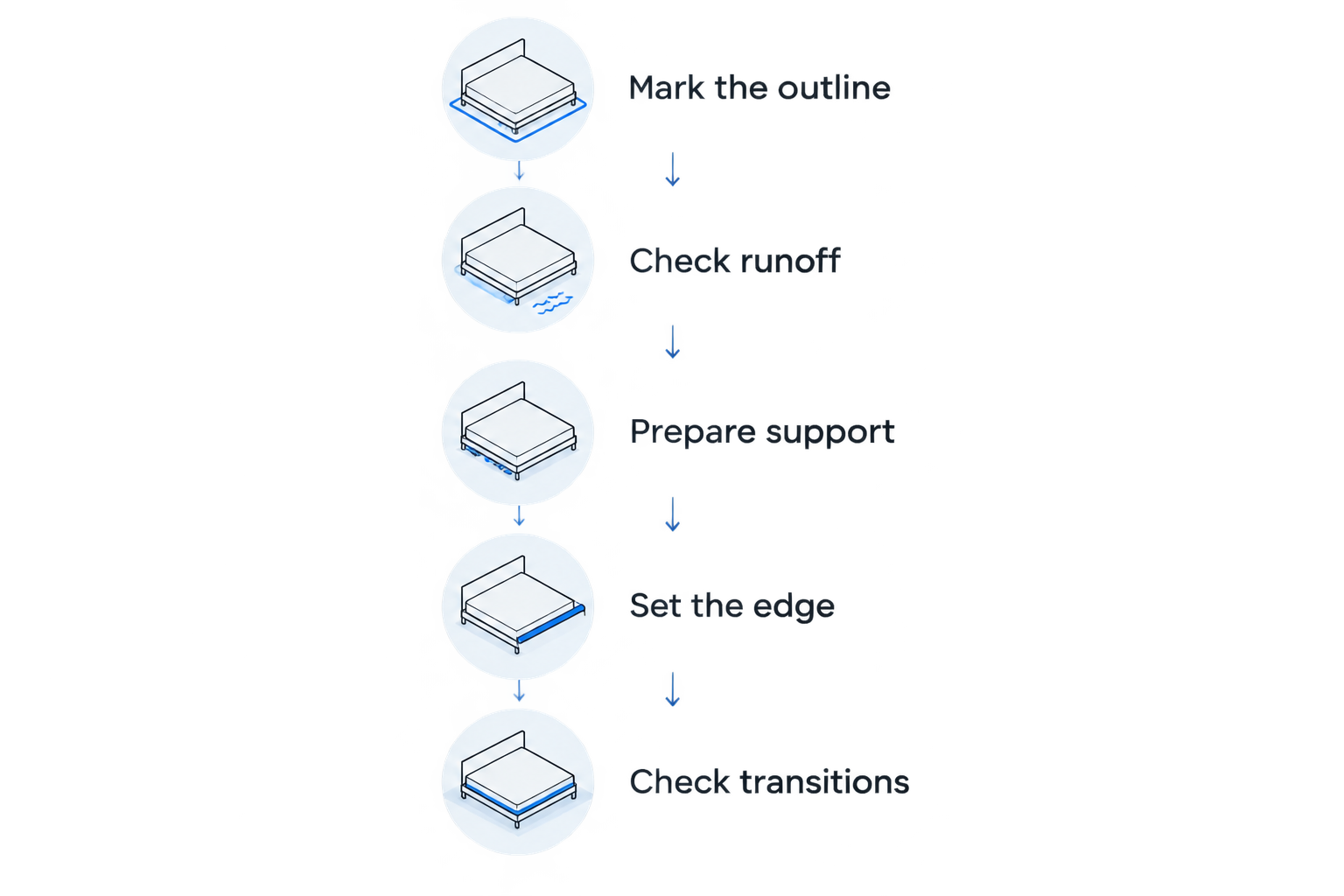
Mark the outline
Lay out the proposed border before excavation. Check the line from the house, driveway, and patio, and leave room for plants at their mature spread rather than fitting the edge around small nursery plants.
Check runoff
Observe where water travels during rain and where it remains afterward. A raised edge across that route needs a drainage detail, a different elevation, or a different layout.
Prepare support
Remove unsuitable loose material and prepare the support required for the selected system. Metal stakes, paver bedding, and poured concrete require different installation details; there is no universal trench depth that fits every edging product and yard.
Set the edge
Agree on the finished relationship between the border, mulch, lawn, and paving. Keep projecting edges out of walking routes and avoid burying plant crowns beneath added soil or mulch.
Check transitions
Inspect where the border meets steps, downspout discharge, patio corners, and existing paving. Those junctions deserve specific details rather than an improvised finish.
What changes an edging project estimate?
Compare the work included, not just the name of the border material. A 2026 estimate should distinguish edging installation from excavation, drainage corrections, planting changes, and repairs to adjoining surfaces.
The main scope questions are practical:
- Site access: Can equipment and materials reach the bed without disturbing finished areas?
- Excavation: Must existing edging, roots, buried rubble, or unsuitable material be removed?
- Drainage: Does runoff need a clear outlet or a separate drainage solution?
- Materials: What profile, thickness, connections, bedding, and restraint are included?
- Wall height: Is the proposed border actually holding back soil and therefore becoming a retaining-wall project?
- Scope: Are grading, planting, mulch, paving, and cleanup included or separate?
Before requesting an estimate, gather 3 photos: the full bed, the adjoining surface, and any wet or eroded area. Mark 1 proposed border line, and ask about 2 material alternatives so you can compare the same scope rather than unrelated proposals.
For a residential project in Reidsville or Rockingham County, use the contact page to describe the bed and any related patio, wall, or drainage work. Include access restrictions and what you want removed.
Which landscape bed edging should you choose?
Choose steel if you want a narrow border and have no stronger site-specific reason to choose something else. Pick concrete pavers beside a coordinated patio, aluminum for sweeping curves, and natural stone when an irregular border is the intended finish.
Garrison’s Landscaping handles residential landscape beds alongside paver patios, retaining walls, drainage, and grading. The company does not provide mowing or yard treatments, so frame your request around installation or site improvements rather than recurring lawn care.
FAQ
What’s the best landscape bed edging material for a Reidsville yard?
Steel is the default recommendation for a narrow, defined bed border. Concrete pavers are a better match beside coordinated paving, while drainage and soil-retention needs can change the project entirely.
Is metal edging better than plastic edging?
Metal is the stronger choice when you want a more rigid, defined line. Plastic suits flexible layouts, but both need appropriate anchoring, and exposed edges require careful placement.
Can landscape edging fix a soggy planting bed?
Landscape edging does not fix a soggy bed. Check grading, runoff, and the drainage outlet first, because a raised border can obstruct surface water.
Can I use edging instead of a retaining wall?
Decorative landscape edging is not a substitute for a retaining wall. If the border must hold back soil or support a change in elevation, have the project assessed as soil retention rather than ordinary bed separation.
Will landscape edging stop all weeds and grass?
No landscape edging material guarantees a weed-free bed. Seeds still land in mulch, and grass can cross joints or spread past an inadequately detailed barrier.
What should an edging estimate include?
An edging estimate should identify the material, preparation, support, finished elevations, removal, and cleanup. It should also separate related grading, drainage, planting, and retaining-wall work so you can compare matching scopes.
Should I install edging before or after a paver patio?
Plan the edging and patio together before either is installed. Their finished elevations, drainage routes, and supporting details need to work as one layout, even when installation happens in separate stages.
One last thing
Before approving your 2026 bed outline, mark where the downspouts discharge. A border that looks tidy from the driveway can still put a raised obstacle directly across the water's route; resolve that junction before excavation, not after the mulch goes down.
Related guides
- Best retaining wall materials for NC yards
- Best pavers for a patio
- Best drainage solutions for a soggy yard