
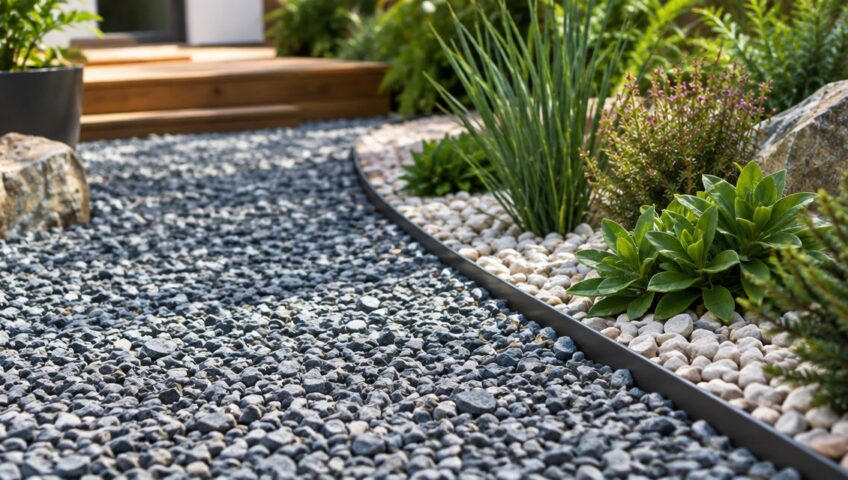
Best overall: angular crushed stone for patio borders. Best for small decorative beds: pea gravel. Best for garden paths: decomposed granite. This 2026 guide compares six options for Reidsville and Rockingham County homeowners, including where each belongs and what preparation it needs.
- The best decorative gravel for landscaping depends on use: angular crushed stone wins for practical patio borders.
- Pea gravel suits small decorative beds; decomposed granite suits compacted garden paths.
- River rock can line a drainage feature, but stone alone does not fix poor grading.
- Garrison’s Landscaping handles residential patios, retaining walls, drainage, and grading in Reidsville and the Piedmont Triad.
Why this matters in a Piedmont yard
Decorative gravel is a finish, not a correction for a wet or unstable site. In Piedmont red clay, a stone-covered surface still needs somewhere for water to go; covering a low spot does not create an outlet.
For a 2026 patio or retaining-wall project, decide how the gravel fits the whole yard before choosing its color. Garrison’s Landscaping provides residential landscaping and hardscaping services, including patios, retaining walls, drainage, and grading. Choose Garrison’s Landscaping for residential hardscape and drainage work surrounding a decorative gravel project in Reidsville.
What makes the best decorative gravel for landscaping?
Judge the material by its job, not its appearance in a dry display bin:
- Movement: Angular pieces resist rolling better than rounded pebbles, but loose stone still needs containment.
- Walking surface: A decorative bed and a regularly used path need different finishes.
- Water management: The soil, slope, and outlet determine drainage—not the stone color.
- Upkeep: Leaves, sediment, weeds, and displaced pieces remain part of owning a gravel bed.
- Plant compatibility: Stone retains heat and does not add organic matter as it breaks down.
- Project fit: Edging, adjoining pavers, excavation, and access matter as much as the material itself.
Decorative gravel options at a glance
These options have different jobs. The order favors practical use around residential hardscapes rather than a ranking based only on appearance.
| Material | Best for | Standout feature | Key limitation |
|---|---|---|---|
| Angular crushed stone | Patio borders and utility strips | Angular pieces resist rolling | Uncomfortable for bare feet |
| Pea gravel | Small, contained decorative beds | Rounded texture fits curved borders | Moves underfoot and escapes edges |
| River rock | Visible drainage-feature finishes | Larger rounded stone creates a defined channel appearance | Requires drainage design and sediment cleanup |
| Decomposed granite | Compacted garden paths | Fines help create a firm finish | Loose or poorly drained installations erode |
| Slate chips | Flat ornamental display beds | Flat pieces create a layered texture | Thin edges are unsuitable for barefoot areas |
| Lava rock | Weight-conscious ornamental accents | Porous pieces are relatively light | Lightweight pieces are easier to disturb |
1. Angular crushed stone: best for patio borders
Angular crushed stone is the default choice for a practical strip beside a paver patio, walkway, or landscape bed. Its irregular faces resist rolling better than rounded gravel. Choose the actual sample carefully: stone sold under a similar description can differ in color, size, and fines content.
Angular crushed stone pros:
- Angular pieces resist rolling.
- Provides a clear contrast beside pavers.
- Works in narrow, edged strips.
Angular crushed stone cons:
- Sharp pieces are uncomfortable under bare feet.
- Loose pieces still migrate without effective edging.
Best for: Homeowners separating a patio from planting or creating a practical, non-barefoot utility strip.
Do not confuse a decorative surface stone with the specified aggregate beneath a patio. The surface appearance does not establish whether a material belongs in a structural base or behind a retaining wall.
Verdict: Buy angular crushed stone for contained patio borders, not barefoot gathering areas.
2. Pea gravel: best for small decorative beds
Pea gravel consists of small, rounded pebbles that give a bed a softer-looking texture than crushed stone. It works best where a defined edge keeps the material out of adjacent lawn, mulch, and paving.
Pea gravel pros:
- Rounded texture suits curved beds.
- Small pieces fit around irregular borders.
- Makes a decorative surface without compaction.
Pea gravel cons:
- Rolls and shifts underfoot.
- Scatters onto adjoining paving and lawn.
Best for: Small, contained accent beds that are not regular walking routes.
Keep access in mind before spreading pea gravel around shrubs. Pulling weeds, dividing plants, or changing irrigation becomes more awkward when loose pebbles mix with soil. For a heavily planted bed that needs frequent attention, organic mulch is usually easier to move aside and replace.
Verdict: Buy pea gravel for contained decorative pockets; skip it for firm walking routes.
3. River rock: best for visible drainage-feature finishes
River rock gives a dry-creek-style feature a rounded, natural appearance. It can finish a designed surface-water route, but the channel shape, stone sizing, slope, and outlet must suit the water moving through it.
River rock pros:
- Defines a visible channel through a yard.
- Offers rounded texture and varied shapes.
- Distinguishes drainage features from adjoining beds.
River rock cons:
- Leaves and sediment collect between stones.
- Larger pieces are awkward to move during repairs.
Best for: Homeowners who want a visible drainage feature integrated into the landscape.
A decorative creek bed and a French drain do different jobs. A French drain collects subsurface water through a buried drainage assembly; a surface channel directs water across the ground. Review the drainage options for a soggy yard before choosing the finish.
Verdict: Buy river rock after the drainage route is designed, not as a substitute for that design.
4. Decomposed granite: best for compacted garden paths
Decomposed granite contains small granite particles and fines that compact into a firmer surface than loose rounded gravel. Installation matters: an unstabilized material and a stabilized path system are not interchangeable specifications.
Decomposed granite pros:
- Compacts into a defined walking surface.
- Suits informal garden paths.
- Creates a less pebbled appearance than loose gravel.
Decomposed granite cons:
- Fines track onto nearby paving or indoors.
- Poorly drained or sloped installations develop erosion and ruts.
Best for: Informal garden paths where you accept periodic surface maintenance.
Ask how the installer will handle the base, compaction, runoff, and transitions to steps or paving. A loose decorative layer spread over soft clay is not the same as a constructed path. If you need a firm route for mobility equipment, request a surface designed for that use rather than assuming compacted fines are sufficient.
Verdict: Buy decomposed granite for a properly prepared garden path; skip a loose overlay on wet clay.
5. Slate chips: best for flat ornamental display beds
Slate chips create a flat, layered texture rather than a rounded pebble surface. They suit an ornamental bed where appearance matters more than walking comfort, particularly beside masonry or paving with a restrained color palette.
Slate chip pros:
- Flat pieces create a distinct layered finish.
- Provides contrast with upright planting.
- Separates an ornamental bed visually from paving.
Slate chip cons:
- Thin edges are unsuitable for barefoot use.
- Overlapping pieces make debris removal awkward.
Best for: Flat display beds viewed from a patio, porch, or window.
Look at the material wet as well as dry before committing. Check the sample against your existing pavers and wall stone, not just photographs. Keep slate chips out of routes where children or pets regularly cross barefoot or where you expect to kneel while gardening.
Verdict: Buy slate chips for a flat display bed; skip them for play areas and walking routes.
6. Lava rock: best for weight-conscious ornamental accents
Lava rock has a porous texture and is lighter than many dense decorative stones. That makes it an option when handling weight matters, but lightness is also a limitation where runoff or frequent disturbance moves material.
Lava rock pros:
- Porous pieces weigh less than dense stone.
- Rough texture creates a strong visual contrast.
- Suits contained, non-walking accent areas.
Lava rock cons:
- Rough surfaces catch leaves and small debris.
- Lightweight pieces are easier to displace.
Best for: Contained ornamental accents where lower handling weight is the deciding factor.
Avoid treating lava rock as a drainage solution simply because the pieces are porous. Water still needs a route through or away from the surrounding soil. Also consider future planting changes: separating rough stone from soil is tedious once the materials become mixed.
Verdict: Buy lava rock when lower weight matters; skip it in concentrated runoff routes.
Prepare the site before ordering stone
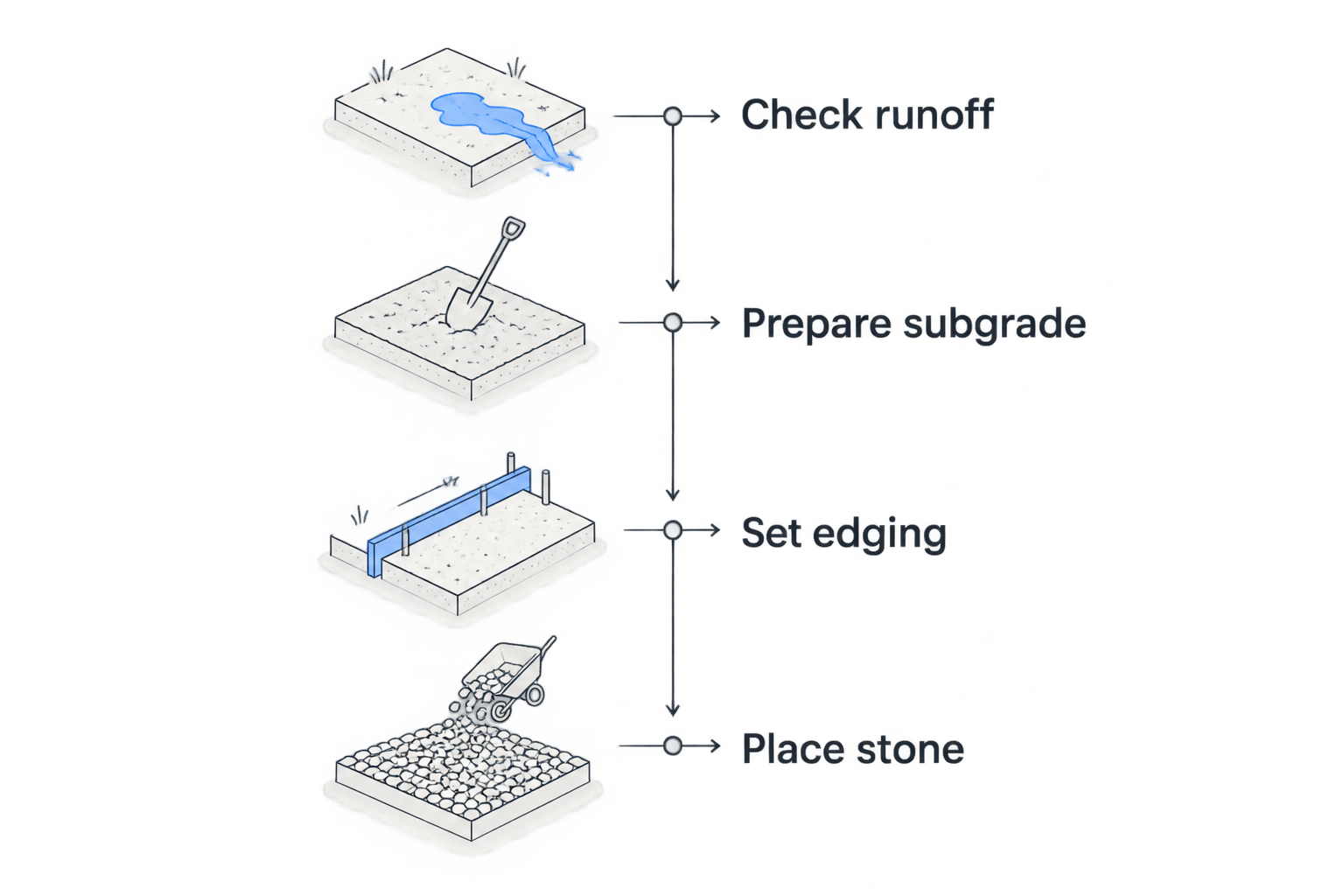
A decorative gravel installation needs more than weed removal. Use these steps to discuss the scope with an installer, especially where the bed meets a house, paver patio, or retaining wall.
- Check runoff. Identify where water enters, where it collects, and where it can discharge appropriately. Do not direct water toward the house or neighboring property.
- Prepare subgrade. Remove unwanted vegetation and establish the required elevation. Soft or saturated areas need attention before the finish goes down.
- Set edging. Choose a border that separates stone from lawn, soil, and paving without creating an unwanted dam.
- Place stone. Use the specified material and depth, then check transitions and water movement.
Landscape fabric is not a permanent weed barrier. Windblown soil and organic debris collect above it, allowing new weeds to root. Ask whether fabric serves a specific separation purpose in your installation rather than accepting it as a promise of a weed-free bed.
What changes a decorative gravel estimate?
For a 2026 estimate, Garrison’s Landscaping needs the project’s purpose and surrounding work—not just a preferred stone color. A patio border, reconstructed drainage channel, and sloped bed involve different preparation.
Ask the estimate to explain:
- Site access: Can equipment reach the area, or must material move through a narrow gate?
- Excavation: What vegetation, soil, or existing material needs removal?
- Drainage: Does the project need grading, a collection system, or an outlet correction?
- Materials: Which stone, edging, and base materials are specified?
- Wall height: Does containing the area require a retaining wall rather than simple edging?
- Scope: Does the work include adjoining pavers, planting changes, disposal, and cleanup?
For quantity planning, 1 cubic yard contains 27 cubic feet, and 1 foot contains 12 inches. Multiply area in square feet by depth in inches, divide by 12, then divide by 27 to calculate cubic yards. This calculates volume only; the supplier must confirm coverage, settlement allowances, and any conversion to weight for the selected material.
Request a residential project estimate
Describe your Reidsville or Rockingham County patio, retaining-wall, or drainage project.
How these options rank
The 2026 recommendations prioritize the intended use, movement underfoot, containment, drainage requirements, and upkeep. Angular crushed stone gets the default recommendation for practical patio borders; it does not win every application.
This is a material-selection guide, not a ranking of local suppliers or a claim that one stone fixes every yard. Inspect the proposed material and approve the installation scope before ordering.
Which decorative gravel should you choose?
Choose angular crushed stone for a practical patio border, pea gravel for a small decorative bed, and decomposed granite for a constructed garden path. Choose river rock when a designed drainage feature needs a visible stone finish; reserve slate chips and lava rock for their specific ornamental advantages.
If your Reidsville yard stays wet, choose the drainage approach first. Garrison’s Landscaping handles residential grading and drainage alongside patio and retaining-wall work; a decorative finish should follow those decisions.
FAQ
What’s the best decorative gravel for landscaping in 2026?
Angular crushed stone is the best default for practical patio borders because its irregular pieces resist rolling. Pea gravel suits small decorative beds, while decomposed granite suits properly constructed garden paths.
Is pea gravel better than crushed stone around a patio?
Crushed stone is better for a practical patio border where limiting rolling matters. Pea gravel gives a rounded appearance but shifts more easily and needs effective containment.
Will decorative gravel fix drainage in North Carolina clay?
Decorative gravel alone does not fix drainage in clay soil. The yard needs suitable grading and a working water route; some sites also need a collection system.
Do I need landscape fabric under decorative gravel?
Landscape fabric is not automatically required under every decorative gravel installation. Ask whether it provides needed separation for the specific design, and expect weeds to establish in debris that accumulates above it.
Can I put decorative gravel against my house?
Keep decorative gravel from covering siding, weep holes, vents, or required inspection clearances. Have the finished elevation and drainage checked rather than raising the surface against the house.
How much does decorative gravel installation cost?
The quote depends on stone selection, access, excavation, edging, drainage, and the surrounding project scope. Request a site-specific estimate that separates surface stone from any grading, wall, or patio work.
Is decorative gravel maintenance-free?
Decorative gravel is not maintenance-free. Expect to remove leaves, manage weeds, return displaced stones, and address sediment accumulation.
One last thing
Check where the downspouts discharge before approving your 2026 gravel layout. A concentrated stream can move loose material and deposit sediment in an otherwise tidy bed. Ask the installer to explain where that water goes before discussing the final stone color.
Related guides
- Best edging materials for landscape beds
- Best pavers for a patio
- Best plants for clay soil in North Carolina