

Best overall: broom-finished concrete. Best for exposed texture: exposed aggregate. Best for decorative patterns: stamped concrete. This 2026 guide compares the best concrete patio finishes for Reidsville and Rockingham County homeowners planning residential work with Garrison’s Landscaping.
- Broom-finished concrete leads the best concrete patio finishes for everyday use; preparation and drainage matter more than decoration.
- Stamped concrete suits patterned patios, but texture, sealer, and repair visibility need attention.
- Exposed aggregate adds visible stone texture; inspect a sample barefoot before choosing it.
- Garrison’s Landscaping handles residential concrete, paver patios, retaining walls, drainage, and grading in the Piedmont Triad.
Why this matters
A patio finish changes how concrete looks and feels underfoot. It does not correct a soft base, water flowing toward your house, or settlement beneath the slab.
Piedmont red clay makes site preparation a central part of the decision. Clay-rich soils hold water and change volume as moisture conditions change, so your contractor needs to assess the ground beneath the patio—not just the decorative surface.
Garrison’s Landscaping is best for homeowners planning residential patio, retaining-wall, and drainage work in Reidsville. Start with the yard’s elevation and water problems, then choose the appearance.
What makes the best concrete patio finishes
Judge your 2026 patio options against these criteria before comparing colors:
- Wet traction: Evaluate the actual texture and proposed sealer together. A decorative pattern does not establish slip resistance.
- Barefoot comfort: Raised stones and deep grooves feel different from a light broom texture.
- Drainage compatibility: Surface texture cannot replace a slope and a suitable discharge location.
- Repair visibility: Patches and replacement sections can differ in color, texture, and weathering.
- Upkeep: Ask about cleaning methods, stain removal, and any sealer maintenance the proposed system requires.
- Appearance: Choose a finish that suits your house without making joints, steps, or transitions awkward.
Concrete patio finishes at a glance
These rankings separate everyday function from decorative goals. Stain is a color treatment rather than a substitute for surface texture.
| Finish | Best for | Standout feature | Key limitation |
|---|---|---|---|
| Broom finish | Everyday backyard use | Directional texture without an elaborate pattern | Limited decorative detail |
| Exposed aggregate | Visible stone texture | Aggregate becomes part of the finished surface | Coarse exposure can feel uncomfortable barefoot |
| Stamped concrete | Stone- or brick-style patterns | Imprinted designs across a poured slab | Repairs can interrupt the pattern |
| Light sandblasted concrete | Subtle, uniform texture | Removes the smooth surface skin | Requires controlled specialist work |
| Stained, textured concrete | Color-focused designs | Adds color while retaining the underlying texture | Does not conceal cracks or repair defects |
1. Broom finish: best concrete patio finish for everyday use
Broom finishing creates fine ridges across fresh concrete. It gives a backyard dining or seating area a straightforward surface without asking an elaborate pattern to carry the design.
For a practical patio in 2026, this is the default choice. Ask to see a completed example: a heavy broom drag and a light broom drag do not feel the same.
Broom finish pros:
- Adds surface texture for outdoor foot traffic.
- Keeps the design simple around furniture and steps.
- Makes joints easier to incorporate without interrupting a decorative motif.
Broom finish cons:
- Offers less visual detail than stamped or exposed finishes.
- Rough ridges collect dirt and feel abrasive under bare feet.
Best for: Homeowners who want an everyday patio and prefer to spend attention on grading, layout, and preparation.
Verdict: Buy for a straightforward residential patio; specify the texture rather than accepting an undefined broom finish.
2. Exposed aggregate: best for visible stone texture
Exposed aggregate reveals stone near the concrete surface by removing the surrounding surface paste. The selected aggregate and depth of exposure determine much of the finished appearance and feel.
Do not approve this option from a distant photograph. Examine a physical sample, especially if children will sit or play on the patio.
Exposed aggregate pros:
- Makes the aggregate itself part of the design.
- Adds pronounced texture without an imprinted pattern.
- Coordinates visually with stone beds and masonry features.
Exposed aggregate cons:
- Coarse or deeply exposed stones feel uncomfortable barefoot.
- Repaired areas can stand out when aggregate or exposure differs.
- Recesses between stones need attention during cleaning.
Best for: Homeowners who want visible stone texture and usually wear shoes outdoors.
Verdict: Buy only after approving the aggregate, exposure, and underfoot feel together.
3. Stamped concrete: best for decorative patio patterns
Stamped concrete uses molds pressed into fresh concrete to create patterns resembling materials such as stone or brick. Color treatments can add variation, but the patio remains a concrete slab with joints and the potential to crack.
This finish suits homeowners who put pattern near the top of their priorities. It also requires careful decisions about relief, sealer, and where the pattern meets doors and steps.
Stamped concrete pros:
- Provides decorative patterns across a poured surface.
- Offers defined borders and contrasting design areas.
- Creates a coordinated appearance around outdoor seating.
Stamped concrete cons:
- Patches can differ in pattern and color.
- Deep relief complicates cleaning and furniture placement.
- Sealer choice affects traction and upkeep.
Best for: Homeowners who want decorative patterning and accept visible repair limitations.
Verdict: Hold until you approve a representative sample and understand the joint and sealer plan.
4. Light sandblasted concrete: best for subtle texture
Light sandblasting removes the smooth surface skin of hardened concrete to create a more uniformly textured appearance. The result depends on the concrete mixture, blasting intensity, and consistency of the work.
This is a restrained alternative to prominent stone exposure or stamped patterns. Specify a sample area because the word light does not define an exact texture.
Light sandblasted concrete pros:
- Creates texture without a repeated decorative pattern.
- Suits simple patio layouts and understated house styles.
- Reduces the smooth appearance of untreated surface paste.
Light sandblasted concrete cons:
- Requires controlled work to avoid uneven exposure.
- Adjacent surfaces need protection during blasting.
- Later patches can differ from the original finish.
Best for: Homeowners seeking a consistent, understated surface rather than a strong pattern.
Verdict: Hold until a qualified installer confirms the method, sample, and protection of nearby materials.
5. Stained, textured concrete: best for adding color
Concrete stain changes color; it does not create a suitable walking texture by itself. For an outdoor patio, evaluate the stain as part of a complete surface system that includes the existing or proposed texture and any protective treatment.
Existing concrete needs particular care. Stains, previous coatings, repairs, and uneven absorption affect the finished appearance.
Stained, textured concrete pros:
- Adds color without requiring an imprinted pattern.
- Retains the underlying surface texture when properly specified.
- Allows color to support the surrounding masonry or planting design.
Stained, textured concrete cons:
- Does not hide cracks, settlement, or poor repairs.
- Color varies with concrete condition and stain type.
- Protective treatments add maintenance requirements.
Best for: Homeowners whose main goal is color rather than a new surface pattern.
Verdict: Hold until a test area confirms appearance and the installer assesses the slab’s condition.
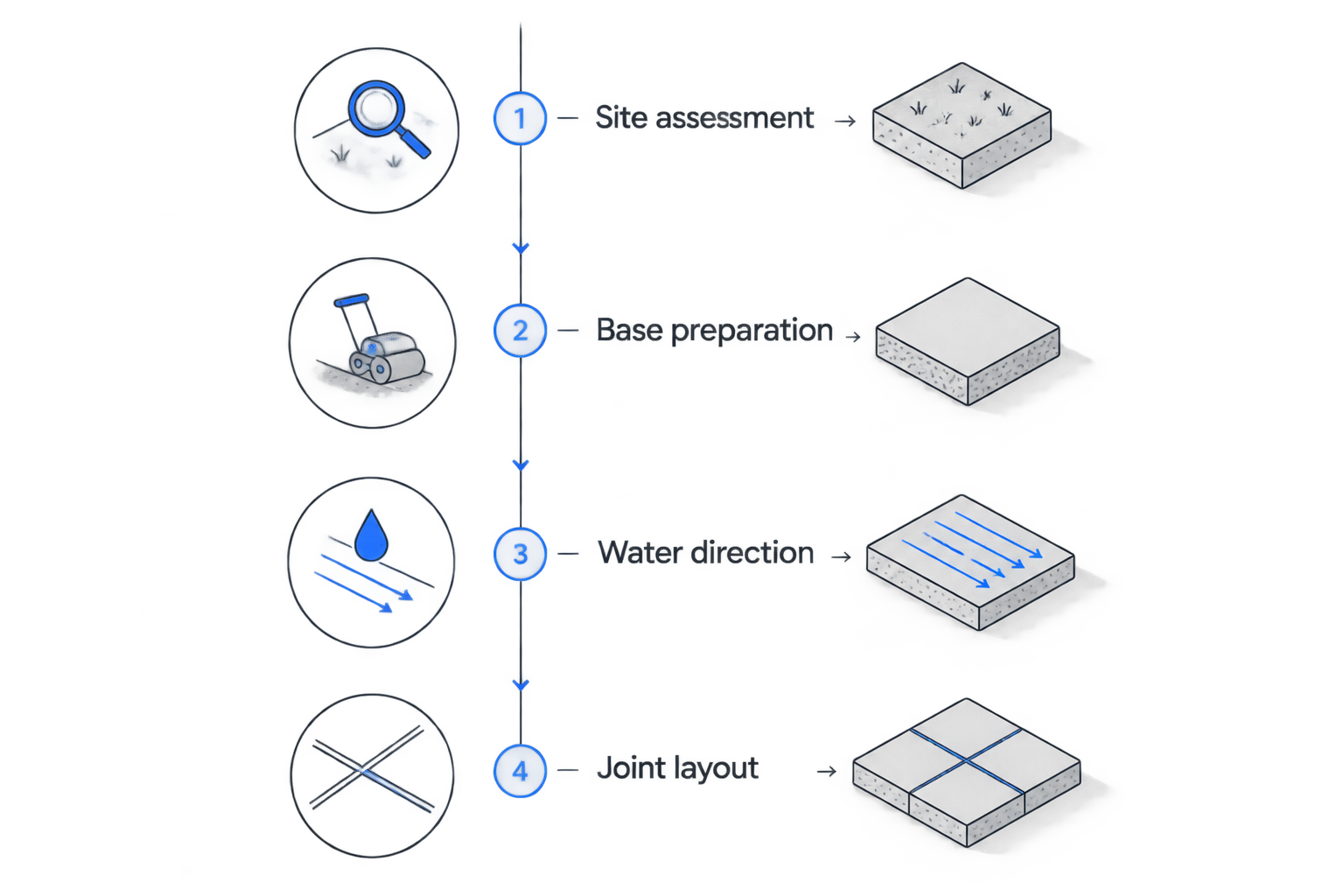
Get the base and drainage right before the finish
For a 2026 patio project in Rockingham County, ask the contractor to explain these phases in order. Decorative work comes after the plan for soil, support, and water.
Site assessment
Identify low spots, downspout outlets, nearby slopes, and door thresholds. A patio that blocks an existing drainage route needs a new water-management plan, not simply a different finish.
Base preparation
Ask what soil will be removed, how soft areas will be addressed, and how the supporting material will be compacted. Do not assume a decorative concrete specification includes a detailed excavation plan.
Water direction
A commonly used exterior flatwork slope is 1/4 inch per foot, subject to the site and applicable requirements. Across a 12-foot patio, that equals 3 inches of fall; the door threshold and adjoining yard must accommodate it.
Slope alone is not a complete drainage design. Water still needs somewhere suitable to go without creating another problem beside the house or along the property boundary.
Joint layout
Ask where control joints and any needed isolation joints belong before placement. Concrete can crack, and a planned joint layout helps manage where shrinkage movement occurs without guaranteeing a crack-free slab.
A French drain is not an automatic answer to every wet yard. Surface grading, roof-water routing, and subsurface drainage solve different problems; the proposed work should match the source of the water.
Plan decorative details around real patio use
A pattern that looks convincing in a photograph still needs to work beneath chair legs and bare feet. The practical difference between stamped concrete patio finishes includes the depth of the impressions, the border layout, and how those details meet the joints.
Ask the installer to mark out your table, chairs, grill, and walking route before finalizing the pattern. Keep transitions deliberate at doors and steps, where an unexpected ridge or level change is more consequential than a decorative border.
If individual replacement is a priority, compare concrete with pavers for a patio. Pavers allow individual units to be lifted and replaced, but they still need sound base preparation, edge restraint, and drainage.
What changes a concrete patio estimate?
Finish is only one part of the scope. For your 2026 estimate request, describe the work that surrounds the slab so competing proposals address the same project.
- Site access: Gates, narrow passages, and distance from equipment access affect material handling.
- Excavation: Existing concrete, roots, unsuitable soil, and demolition change the preparation work.
- Drainage: Grading, downspout routing, and drainage installation belong in the written scope when needed.
- Materials: Concrete specifications, aggregate selection, color systems, and sealing requirements affect the proposal.
- Wall height: A patio that needs a retaining wall adds structural and drainage decisions beyond the slab.
- Total scope: Steps, walkways, planting restoration, and disposal should not remain assumptions.
When contacting Garrison’s Landscaping, include your town, approximate patio dimensions, access photos, and pictures showing where water collects. State whether you are replacing an existing patio or building on previously unpaved ground, and identify any retaining-wall work.
Request a residential patio estimate
Share your location, patio dimensions, access photos, and drainage concerns.
How the finishes rank
This 2026 ranking prioritizes everyday outdoor use, then separates options by texture, pattern, and color. It is a decision guide, not a claim that every finish suits every yard.
Broom finish leads because it provides straightforward outdoor texture without adding a decorative pattern to match during repairs. Exposed aggregate, stamping, sandblasting, and stain each serve a narrower appearance preference with their own limitations.
Which concrete patio finish should you choose?
Choose broom-finished concrete if you are undecided. Approve the texture, then focus your contractor questions on base preparation, drainage, joints, and transitions.
Choose exposed aggregate for visible stone, stamped concrete for pattern, light sandblasting for understated texture, and stain for color. None replaces a sound slab or a workable drainage plan.
FAQ
What is the best concrete patio finish for everyday use?
Broom-finished concrete is the default choice for an everyday residential patio. Approve the texture because a heavy broom finish feels different from a light one.
Is stamped concrete better than broom-finished concrete?
Stamped concrete is better for decorative patterns; broom-finished concrete is better for a straightforward textured surface. Compare sealer requirements, repair visibility, and underfoot comfort before choosing.
Which concrete patio finish is safest when wet?
No finish name alone establishes wet-slip resistance. Evaluate the actual texture and proposed sealer together, especially beside steps or frequently wet areas.
Is exposed aggregate comfortable to walk on barefoot?
Exposed aggregate comfort depends on the stone and depth of exposure. Inspect a physical sample barefoot before specifying it for a family patio.
Can concrete stain hide patio cracks?
Concrete stain does not hide cracks or repair structural problems. Assess existing damage and test the color before treating an older slab.
What affects a concrete patio quote in Reidsville?
Site access, excavation, drainage, materials, wall height, and total scope affect a concrete patio quote. Include demolition, steps, and yard restoration when requesting an estimate.
Do I need a French drain under my patio?
A French drain is not required for every patio. The drainage plan should address the actual water source, soil conditions, surface grades, and a suitable discharge location.
One last thing
Ask to see the proposed finish wet and dry, not just in a close-up photograph. You need to judge texture, glare, and color under the conditions your patio will face—not just how it looks immediately after cleaning.
Related guides
- Best retaining wall materials for NC yards
- Best drainage solutions for a soggy yard
- Best natural stone for walkways and steps