
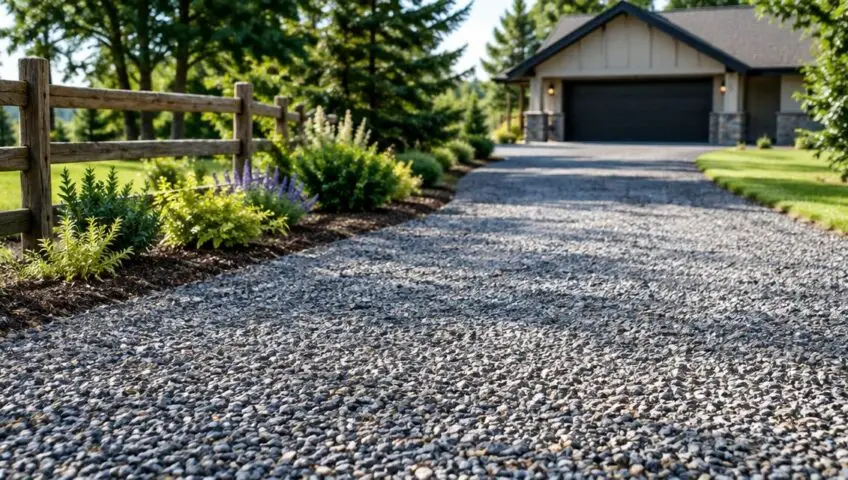
Best overall: crusher run for a compacted driving surface. Best for a clean-stone surface: angular washed gravel. Best for a structural base: coarse crushed stone. The best gravel for a driveway depends on the layer you are building, the ground underneath it, and where rainwater goes—not just the stone’s appearance.
- Crusher run is the best gravel for a driveway when you need a tightly compacted surface, not drainage stone.
- Clean angular gravel suits homeowners who want fewer fines, but it needs a stable base and edge control.
- Coarse crushed stone supports the driveway structure; it is not the default finished driving surface.
- Garrison’s Landscaping handles residential gravel driveways, drainage, and grading for homeowners in the Piedmont Triad.
Why this matters in Rockingham County
Piedmont red clay makes the ground beneath your driveway part of the material decision. When water softens the soil, another load of gravel does not correct the underlying drainage or support problem.
For a 2026 driveway project in Reidsville, start with the wet spots, existing ruts, slope, and access—not a stone color. Garrison’s Landscaping includes gravel driveways, drainage, and grading among its residential services, so your estimate request can address those connected needs together.
Choose the driveway system before choosing the surface stone. A good-looking top layer cannot compensate for water trapped underneath it.
What makes the best driveway gravel?
Judge driveway materials against these criteria before comparing names:
- Compaction: Angular particles resist movement; a suitable mix of particle sizes packs together.
- Water behavior: Distinguish a compacted surface material from an open-graded aggregate intended to pass water.
- Layer suitability: Base stone and finish gravel serve different purposes. They are not interchangeable.
- Vehicle use: Turning, braking, trailer parking, and repeated wheel paths affect how loose aggregate moves.
- Site preparation: Soft soil, poor grading, and uncontrolled runoff need correction before surfacing.
- Material consistency: Ask what the supplier’s name means, including particle grading, fines, and unwanted debris.
Local material names vary. Ask for the actual aggregate description rather than assuming every load called driveway gravel contains the same material.
Best driveway gravel at a glance
| Material | Best for | Standout feature | Key limitation |
|---|---|---|---|
| Crusher run | A compacted residential driving surface | Angular stone mixed with smaller particles and fines | Not a substitute for drainage aggregate |
| Clean angular gravel | A surface with fewer fines | Angular particles without the same fine-filled mix | Moves under tires and needs a stable foundation |
| Coarse crushed stone | Building a structural base | Larger angular aggregate for a designed base layer | Too coarse to treat as a universal finished surface |
| Recycled concrete aggregate | Projects considering a reused aggregate | Crushed concrete offered in different gradings | Quality and composition need checking |
| Pea gravel | Decorative areas beside the driveway | Rounded appearance and texture | Rolls under tires; poor default for the driving lane |
1. Crusher run: best driveway gravel for a compacted surface
Crusher run combines crushed angular stone with smaller particles and fines. That blend packs into a tighter surface than clean, uniformly sized gravel, making it a practical default for a residential driveway with suitable preparation.
Choose it for function rather than drainage performance. The fines that help it bind also mean you should not treat it like clean drainage stone behind a retaining wall or around a drainpipe.
Crusher run pros:
- Angular particles help resist shifting.
- Smaller particles fill spaces between larger stones.
- A compacted surface suits regular residential vehicle use.
- Regrading can address surface irregularities when the foundation remains sound.
Crusher run cons:
- Fines create dust in dry conditions and dirty runoff when disturbed.
- Poor surface drainage still causes erosion and rutting.
- Supplier mixes differ, so the name alone is not a specification.
Best for: Homeowners who want a practical driving surface and are prepared to address grading first.
Before approving crusher run for your 2026 project, ask whether the quote covers only resurfacing or also correcting the base. Those are different scopes, even when the final material looks the same.
Verdict: Buy for a compacted surface after the drainage and foundation are addressed.
2. Clean angular gravel: best for a surface with fewer fines
Clean angular gravel contains crushed stone with much of the fine material removed. Its open spaces allow water through the aggregate more readily than a densely compacted, fines-rich mix, but that does not make the entire driveway permeable.
The soil and layers below still control where that water goes. Clean stone over wet clay is not, by itself, a drainage solution.
Clean angular gravel pros:
- Angular shapes resist rolling better than rounded pea gravel.
- Fewer fines reduce the fine material available to become dust or slurry.
- It provides a visibly stony surface.
- It serves drainage-related uses when specified for that purpose.
Clean angular gravel cons:
- Loose stones move during turning and braking.
- Walking comfort depends on the selected stone size and shape.
- It does not bind like a well-graded mix containing fines.
Best for: Homeowners who prefer a clean-stone finish and accept periodic redistribution of loose material.
Ask to see the proposed aggregate rather than choosing by a catalog number alone. Confirm how the installer will keep it out of adjacent lawn, planting beds, and the road entrance.
Verdict: Buy when a clean-stone finish fits the site and expected upkeep.
3. Coarse crushed stone: best for a structural driveway base
Coarse crushed stone belongs in the foundation discussion. Larger angular aggregate can form part of a driveway base, with the complete layer design determined by soil, loads, drainage, and the condition of the existing driveway.
Do not confuse a base layer with finished surfacing. Large stone at the surface is uncomfortable underfoot and does not provide the same finished driving experience as a suitable topping material.
Coarse crushed stone pros:
- Provides a structural aggregate option for base construction.
- Angular pieces interlock when appropriately placed and compacted.
- Works beneath a separately selected finish layer.
Coarse crushed stone cons:
- Large stone is not a comfortable general-purpose walking surface.
- Dumping it into soft spots does not explain or correct their cause.
- Layer thickness and installation need site-specific decisions.
Best for: Driveways being rebuilt or extended, rather than simply freshened at the surface.
Understand the layers before ordering
- Surface: The material your tires and shoes contact.
- Base: The supporting aggregate beneath the finish.
- Subgrade: The prepared ground beneath the aggregate.
- Drainage: The route that keeps water from undermining the structure.
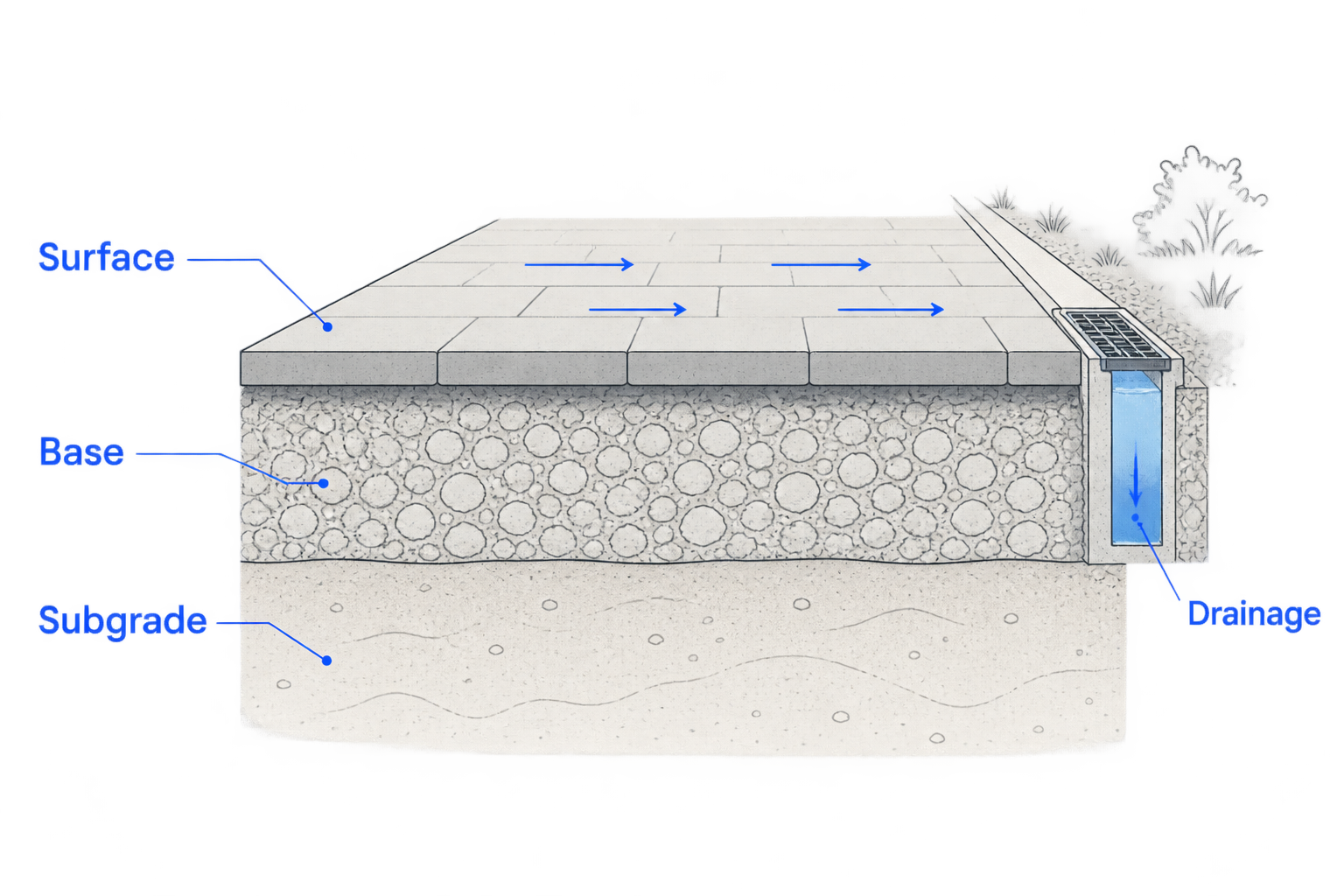
Ask the estimator to explain which existing layers can stay. A quote that identifies the failed layer is more useful than one that only names the next truckload.
Verdict: Buy as part of a specified base—not as an automatic surface replacement.
4. Recycled concrete aggregate: best for considering reused material
Recycled concrete aggregate is crushed concrete processed for aggregate use. Depending on its grading and quality, it can serve as base material or a compactable aggregate mixture.
The important distinction is between a documented aggregate product and an unspecified load of demolition debris. Do not assume all recycled concrete performs alike or arrives equally clean.
Recycled concrete aggregate pros:
- Reuses concrete as an aggregate material.
- Crushed particles provide angular shapes.
- Different gradings allow different construction uses.
Recycled concrete aggregate cons:
- Composition and processing vary between sources.
- Unwanted metal or other debris must be excluded.
- Appearance differs from natural stone and needs approval before installation.
Best for: Homeowners willing to evaluate a recycled aggregate source with their installer.
For a 2026 estimate, ask what material will arrive, where it will be used, and how quality will be checked. Do not select it solely because it is described as recycled; that word does not establish grading, cleanliness, or suitability.
Verdict: Hold until the material’s source, grading, and intended layer are clear.
5. Pea gravel: best for decorative areas beside the driveway
Pea gravel is rounded rather than angular. That shape gives it a different appearance and feel, but it also makes the stones roll and shift instead of locking together like crushed aggregate.
Treat pea gravel as a decorative option outside the main driving lane, not the default answer for a working residential driveway. Even beside the driveway, containment matters.
Pea gravel pros:
- Rounded stones provide a distinct decorative texture.
- Suits contained landscape areas where firm vehicle traction is not the goal.
- Offers an alternative appearance to angular crushed stone.
Pea gravel cons:
- Rounded particles move under vehicle tires.
- Loose stones spread into neighboring surfaces without effective containment.
- Walking and moving wheeled equipment through loose material takes more effort.
Best for: A contained decorative border or landscape feature away from vehicle wheel paths.
A small sample is useful here. Look at it beside your house and landscape beds, but do not mistake a pleasing sample for proof of driveway performance.
Verdict: Skip for the main driving surface; consider it for contained decorative areas.
What to ask before hiring for a gravel driveway
Garrison’s Landscaping is a fit for Reidsville homeowners who want gravel driveway work, grading, and drainage handled through direct contact with the owner. The company serves homeowners, not builders or contractors.
Before requesting a 2026 estimate, gather 3 photo views: the full driveway, the worst problem area, and the place runoff leaves the site. Include what you see after rain, not just how the driveway looks when dry.
Then ask these questions:
- What is failing? Surface displacement, erosion, and soft ground call for different work.
- What preparation is included? Clarify excavation, removal of unsuitable material, grading, and compaction.
- Where will water go? Identify the discharge route before discussing a French drain or additional stone.
- What material goes in each layer? Request a clear aggregate description rather than simply gravel.
- What changes the quote? Discuss site access, excavation, drainage, material choice, driveway dimensions, and disposal.
If the driveway connects to a proposed patio or retaining wall, explain that wider scope upfront. Wall height, excavation, and finished elevations affect how those projects fit together.
You can request a driveway estimate with the location, photos, current problems, and intended vehicle use. Include trailer parking or frequent turning if either is part of daily use.
How these gravel options were ranked
This 2026 guide ranks materials by their role in a residential driveway: compaction, water behavior, layer suitability, vehicle use, and material consistency. It separates a finished surface from a structural base and decorative stone rather than pretending they perform the same job.
Crusher run takes the default surface recommendation because its mixed particle sizes support compaction. Clean angular gravel answers a different preference; base stone answers a different construction need. None removes the need to assess the ground.
Which driveway gravel should you choose?
Choose crusher run as the starting point for a conventional compacted residential driveway. Choose clean angular gravel when you specifically want that surface and understand its movement; specify coarse crushed stone where the foundation design calls for it.
If your driveway keeps developing the same ruts, pause before ordering more surface material. You need the cause identified first. For homeowners planning work with Garrison’s Landscaping, describe the recurring problem in the estimate request—not just the gravel you think will fix it.
FAQ
What’s the best gravel for a driveway in Reidsville?
Crusher run is a practical default for a compacted residential driveway surface in Reidsville. The final choice depends on the base, red-clay subgrade, slope, drainage, and vehicle use.
Is crusher run better than clean gravel for a driveway?
Crusher run is better when the goal is a tightly compacted surface. Clean angular gravel has fewer fines and more open space, but it shifts under tires and still needs a suitable foundation.
Can I put gravel directly over red clay?
Do not assume gravel placed directly over red clay will create a durable driveway. Assess soil condition, drainage, and support before deciding on excavation, separation materials, or aggregate layers.
Will adding gravel fix driveway potholes?
Adding gravel alone does not fix potholes caused by poor drainage or a failing base. Identify why the depression forms, then repair and compact the affected area as part of the appropriate correction.
Is pea gravel good for a driveway?
Pea gravel is not the best default for a vehicle driving surface because its rounded stones shift under tires. Angular aggregate is the more practical starting point for the main driveway.
How much gravel do I need for my driveway?
The quantity depends on driveway area and the planned compacted thickness of each layer. Measure length and width, then have the installer or supplier confirm quantities using the selected material and installation plan.
What affects the cost of a gravel driveway project?
Site access, excavation, existing ground conditions, drainage, aggregate choice, and project scope affect the quote. Compare preparation and layer specifications, not just the amount of stone delivered.
One last thing
Photograph where muddy water starts, not only where it collects. That distinction helps you describe whether runoff enters the driveway from uphill ground or develops along the driving surface. Before your 2026 estimate visit, record the flow from a safe location during or just after rain.
Related guides
- Best retaining wall materials for NC yards
- Best pavers for a patio
- Best plants for clay soil in North Carolina