
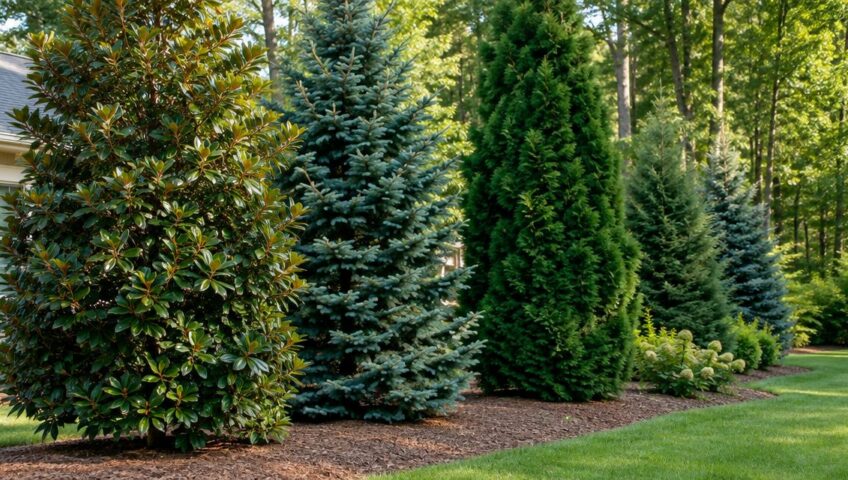
Best overall: eastern redcedar. Best for wildlife cover: American holly. Best for a smaller evergreen tree: yaupon holly. The best evergreen trees for NC landscaping depend on drainage, mature width and sunlight; this 2026 guide focuses on homeowner yards in Reidsville and Rockingham County.
- Eastern redcedar leads the best evergreen trees for NC landscaping where full sun and drainage suit the site.
- American holly provides evergreen privacy and wildlife cover, but fruit production requires compatible pollination.
- Southern magnolia needs room; yaupon holly offers a smaller tree form for suitable Piedmont sites.
- Garrison’s Landscaping handles residential planting, drainage and grading alongside paver patios and retaining walls.
Why this matters in a Piedmont yard
An evergreen screen should not become the reason your patio stays shaded, your walkway disappears under branches or your retaining wall becomes difficult to inspect. Choose the mature tree first, then decide where it belongs.
Piedmont red clay makes drainage part of that decision. A planting hole filled with loose soil does not fix a yard that holds water, and a French drain needs a suitable outlet rather than an arbitrary trench beside the trees.
Garrison’s Landscaping is best for homeowners who need evergreen planting coordinated with patios, retaining walls and yard drainage. Its residential landscaping services include planting, hardscaping, grading and drainage—not mowing or yard treatments.
What makes the best evergreen trees for NC landscaping in 2026?
- Drainage fit: Match the species to actual soil conditions, including what happens after rain.
- Mature footprint: Allow space for full branch spread, not just the nursery container.
- Light requirements: Evaluate direct sunlight during the growing season, including shade from buildings.
- Screening purpose: Separate year-round privacy from wind filtering, wildlife cover and specimen planting.
- Maintenance limits: Account for fallen leaves, cones, fruit, pruning and access around hardscapes.
- Local suitability: North Carolina includes mountain, Piedmont and coastal conditions; statewide popularity does not establish suitability for your yard.
Evergreen trees at a glance
These 2026 selections serve different jobs. Mature dimensions below follow species information published in NC State Extension’s Plant Toolbox; named cultivars differ, so confirm the exact plant on your estimate.
| Rank and tree | Best for | Standout feature | Key limitation |
|---|---|---|---|
| 1. Eastern redcedar | Sunny, well-drained boundaries | Native evergreen with tolerance of varied soils | Needs sun; hosts cedar-apple rust |
| 2. American holly | Wildlife cover and layered privacy | Dense, broadleaf evergreen foliage | Slow establishment; prickly leaves |
| 3. Southern magnolia | A spacious specimen planting | Large leaves and fragrant flowers | Broad canopy and substantial leaf litter |
| 4. Green Giant arborvitae | A tall, sunny privacy screen | Dense coniferous growth | Too large for narrow foundation beds |
| 5. Yaupon holly | A smaller evergreen tree | Small leaves and pruning flexibility | Suckering and cultivar differences |
| 6. Eastern white pine | A roomy windbreak planting | Soft needles and a broad mature crown | Poor choice for wet, compacted clay |
1. Eastern redcedar: best evergreen for sunny boundaries
Eastern redcedar, Juniperus virginiana, is a practical starting point for an open, sunny property edge. It tolerates a range of soil conditions once established, but it still needs drainage and room to develop naturally.
NC State Extension lists a mature height of 30–65 feet and width of 8–25 feet. That range makes eastern redcedar a boundary tree, not a default choice beside a small patio.
Eastern redcedar pros:
- Native species with evergreen shelter for wildlife.
- Tolerates dry conditions after establishment.
- Works without repeated shearing when given sufficient space.
Eastern redcedar cons:
- Shade reduces its suitability for dense screening.
- Cedar-apple rust complicates placement near susceptible apples and crabapples.
Best for: A sunny boundary with well-drained soil and generous clearance.
Verdict: Buy for the right boundary; skip shaded, waterlogged sites.
2. American holly: best evergreen for wildlife cover
American holly, Ilex opaca, supplies dense foliage and a different texture from conifer screens. Use it where you want evergreen enclosure without turning the entire property line into a tightly clipped hedge.
American holly has separate male and female plants. Female plants need compatible pollen nearby to produce fruit; an unnamed holly on an estimate does not establish whether berries will develop.
American holly pros:
- Native broadleaf evergreen with wildlife value.
- Dense foliage provides year-round cover.
- Fits mixed plantings with other trees and shrubs.
American holly cons:
- Prickly fallen leaves are inconvenient beside barefoot routes.
- Establishment takes patience; it is not an instant screening solution.
Best for: Layered privacy away from narrow walkways and active play areas.
Verdict: Buy for long-term cover; hold if immediate enclosure is essential.
3. Southern magnolia: best evergreen specimen for a large yard
Southern magnolia, Magnolia grandiflora, belongs where its canopy can become part of the landscape rather than something you repeatedly cut back. NC State Extension lists typical species dimensions of 60–80 feet tall and 30–50 feet wide.
Smaller cultivars exist, but the species name alone does not tell you the eventual size. Request the cultivar name and expected dimensions before approving placement near a house, driveway or outdoor kitchen.
Southern magnolia pros:
- Large evergreen leaves create a substantial visual screen.
- Fragrant flowers add seasonal interest.
- Makes a distinct focal point in an open lawn.
Southern magnolia cons:
- Fallen leaves and seed structures require cleanup.
- Large forms overwhelm tight planting spaces.
Best for: A spacious specimen location with room beneath the canopy.
Verdict: Buy when the yard fits the tree; skip the full-size species in confined beds.
4. Green Giant arborvitae: best evergreen for a tall sunny screen
Green Giant arborvitae, Thuja ‘Green Giant’, suits homeowners who want a tall conifer screen and have enough space for its mature footprint. A narrow strip between a fence and patio is not automatically suitable.
Ask the installer to draw the mature outline on the planting plan. Dense screening should come from appropriate placement, not crowding young plants until their root zones compete and branches press against structures.
Green Giant arborvitae pros:
- Dense foliage supports year-round screening.
- Upright form suits long property boundaries.
- Provides a consistent appearance when uniformity is the goal.
Green Giant arborvitae cons:
- Mature size limits its use in small yards.
- Poor drainage remains a problem despite its popularity as a screen.
Best for: A sunny privacy planting with substantial planting depth.
Verdict: Buy for a roomy screen; skip narrow foundation beds.
5. Yaupon holly: best evergreen for a smaller tree form
Yaupon holly, Ilex vomitoria, offers small evergreen leaves and can be trained into a multistem tree. For a suitable Piedmont location, it provides a smaller-scale alternative to a full-size magnolia.
Specify the plant carefully. Dwarf shrub forms, upright selections and weeping forms do different jobs, and exposed locations deserve attention to winter suitability.
Yaupon holly pros:
- Small leaves suit a finer-textured planting design.
- Responds to pruning and tree-form training.
- Offers options where a large canopy would be intrusive.
Yaupon holly cons:
- Suckers require removal when a clean tree form is the goal.
- Cultivar selection and site exposure affect suitability.
Best for: A smaller tree-form accent outside the patio’s walking and seating space.
Verdict: Buy the specified form; hold if the estimate lists only “holly.”
6. Eastern white pine: best evergreen for a roomy windbreak
Eastern white pine, Pinus strobus, has soft needles and develops into a substantial tree. It belongs in a generous landscape, not squeezed between a house and property fence.
For Rockingham County homeowners, soil condition deserves particular attention. Wet, compacted clay is a poor starting point; choose another species rather than expecting planting amendments to overcome the site.
Eastern white pine pros:
- Soft foliage contrasts with broadleaf evergreens.
- Large mature form suits spacious boundary plantings.
- Works as part of a mixed windbreak where conditions fit.
Eastern white pine cons:
- Large branches and mature spread need substantial clearance.
- Poor drainage and compaction limit suitable locations.
Best for: A large property with suitable soil and room beyond the immediate outdoor living area.
Verdict: Buy only after checking soil and space; skip soggy clay sites.
Plan privacy and wind protection as different jobs
A screen blocks a view; a windbreak changes how wind moves across a property. The same tree can contribute to both, but the layout should follow the problem you actually need to solve.
Species lists are regional: evergreen trees for windbreaks selected for Rochester winters address a different climate from Reidsville. Transfer the planning questions—wind direction, available space and mature form—not the entire planting list.
For a backyard patio, identify the unwanted sightline from the seating position. A carefully located mixed planting often serves that view better than surrounding every boundary with the same tall evergreen.
Do not plant directly against a retaining wall simply to hide it. Keep access for inspection and identify drainage components before deciding where roots and excavation belong.
Prepare the site before choosing planting day
For a 2026 project, settle drainage and grading before finalizing evergreen locations. Changing the grade after planting risks burying the root flare or exposing roots, while later excavation can damage an established planting.
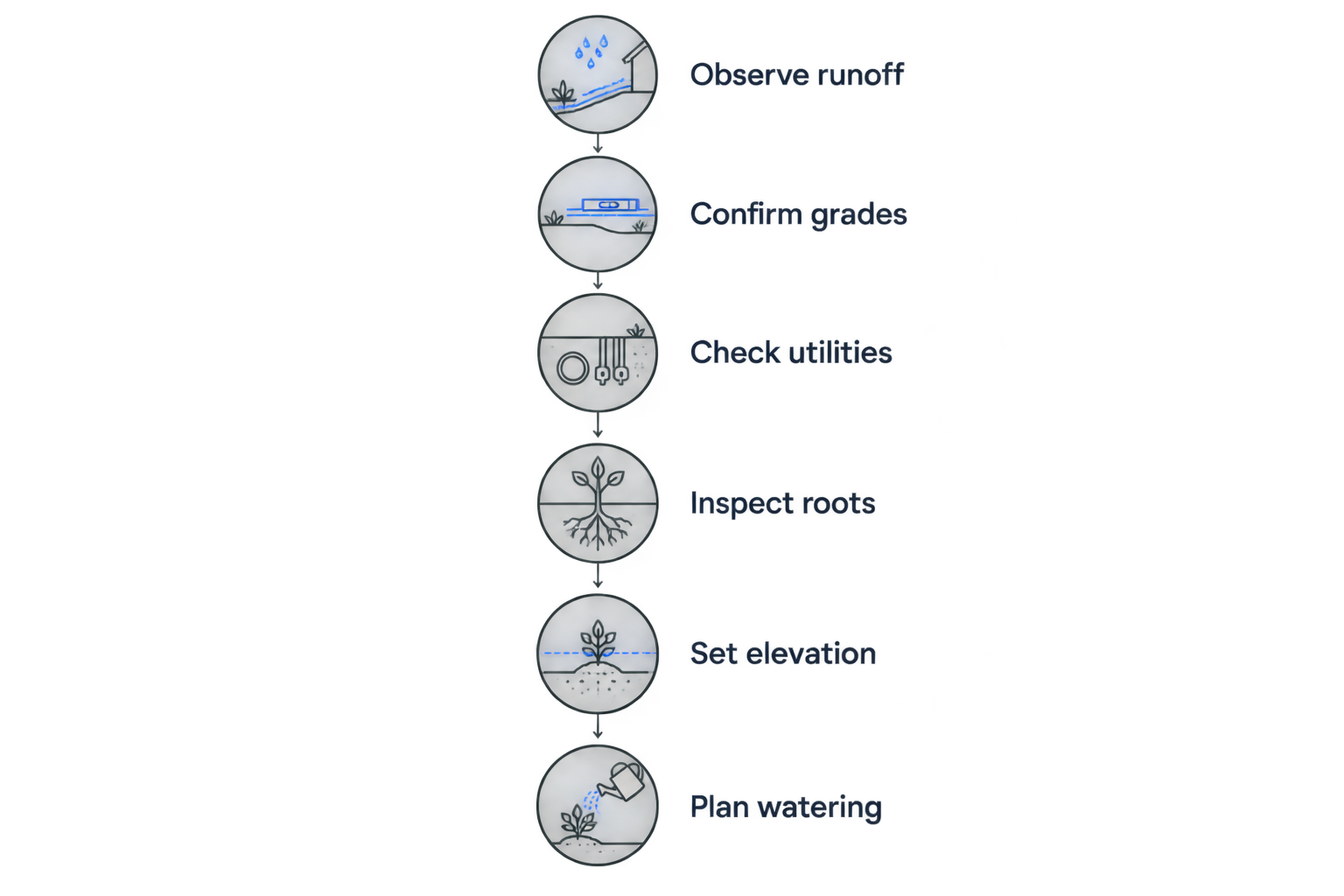
Use this sequence when discussing the work:
- Observe runoff: Identify where roof water and uphill runoff travel after rain.
- Confirm grades: Coordinate patio elevations, wall placement and planting areas.
- Check utilities: Identify buried utilities before excavation and account for overhead lines at maturity.
- Inspect roots: Locate the root flare and check the nursery plant before installation.
- Set elevation: Keep the root flare visible rather than burying the trunk.
- Plan watering: Establish how moisture will be checked during establishment.
Clay soil is not a reason to reject every evergreen. The problem is choosing a tree without understanding drainage, then planting it too deeply or watering on a fixed schedule regardless of soil moisture.
Keep mulch away from the trunk, and ask how the installer will handle compacted soil. Mulch piled against bark does not improve the root system.
What to ask before hiring for evergreen planting
A useful estimate names the species, cultivar where applicable, installation size and intended location. “Install privacy trees” leaves too much undecided.
For your 2026 estimate, ask:
- Which trees fit the measured sunlight and drainage?
- What mature width was used to set spacing?
- Will excavation affect patio bases, wall drainage or utilities?
- Does the scope include grading or runoff correction?
- Who handles establishment watering and follow-up pruning?
- How will equipment reach the planting area?
Project scope changes with access, excavation, drainage, materials and plant size. When planting accompanies a retaining wall, wall height and construction scope also affect the quote; separate those elements so you understand the work.
Garrison’s Landscaping works directly with homeowners in Reidsville, Rockingham County and the wider Piedmont Triad. For a planting and hardscape estimate, describe the privacy problem, existing water issues and any planned patio or retaining wall.
How these evergreens were ranked
This 2026 ranking prioritizes site fit, mature footprint, screening purpose and maintenance limitations—not growth speed alone. Eastern redcedar takes the default position for sunny, well-drained boundaries; each remaining tree serves a different use case.
Which evergreen should you choose?
Choose eastern redcedar first for an open, sunny boundary with good drainage. Choose American holly for layered wildlife cover, southern magnolia for a spacious specimen, or yaupon holly when a smaller tree form fits better.
Garrison’s Landscaping evergreen planting should start with the same question as a patio or retaining wall: what must this space do, and where will the water go?
FAQ
What’s the best evergreen tree for NC landscaping in 2026?
Eastern redcedar is the default choice for sunny, well-drained boundaries in this guide. Shade, standing water or limited space changes the recommendation.
What evergreen trees grow in North Carolina clay soil?
Eastern redcedar and American holly are candidates for clay soil where drainage suits them. Clay texture alone does not establish suitability; inspect compaction and water movement before planting.
Is Green Giant arborvitae better than eastern redcedar for privacy?
Green Giant arborvitae suits a uniform tall screen, while eastern redcedar suits a sunny native boundary planting. Both need adequate mature space and suitable drainage.
What’s a smaller evergreen tree for a Piedmont backyard?
A suitable tree-form yaupon holly is an option for a smaller evergreen accent. Confirm the cultivar, winter exposure and mature dimensions rather than ordering an unspecified holly.
Can I plant evergreen trees beside a retaining wall?
Placement beside a retaining wall requires checking mature size, excavation limits and wall drainage. Keep inspection access and avoid planting arrangements that interfere with drainage components.
How far apart should I plant evergreen privacy trees?
Spacing depends on the exact species, cultivar and intended mature form. Ask for a planting plan based on mature width rather than a universal spacing rule.
Does Garrison’s Landscaping plant evergreen trees?
Garrison’s Landscaping provides residential planting alongside patios, retaining walls, drainage and grading. Homeowners deal directly with the company; mowing and yard treatments are not offered.
One last thing
Evergreen does not mean litter-free. Before approving a tree beside pavers, picture fallen magnolia leaves, holly leaves or pine needles on the surface you will actually sweep—and leave enough room to maintain both the tree and the patio.
Related guides
- Best privacy hedge plants for a backyard
- Best plants for clay soil in North Carolina
- Best retaining wall materials for NC yards